A detailing estimate and a detailing quote both tell the customer what a job may cost, but they are useful at different stages of the booking process.
An estimate is useful when the final scope is not completely known. A quote is better when you understand the vehicle, service and agreed work well enough to give the customer a more definite price.
Quick answer
Use an estimate when important job details can still change. Use a quote when the scope and price are sufficiently defined.
For mobile detailing, photos, customer intake and vehicle condition often determine whether you can move directly to a quote or should start with an estimate and confirm the final price after inspection.
This guide focuses on communicating the price to the customer. For the calculation behind that price, start with our Mobile Detailing Pricing Guide, then see How Much Should You Charge for Mobile Detailing?, our Mobile Detailing Hourly Rate guide, Mobile Detailing Travel Fees and How to Price Mobile Detailing Add-ons.
Detailing estimate vs. quote: what is the practical difference?
In everyday business use, an estimate normally communicates an approximate expected price, while a quote communicates a more defined price for a defined scope of work.
| Document | Best used when | Pricing certainty |
|---|---|---|
| Estimate | Vehicle condition, labor or final scope is still uncertain | Approximate or conditional |
| Quote | Scope, condition and requested services are sufficiently understood | More definite for the specified scope |
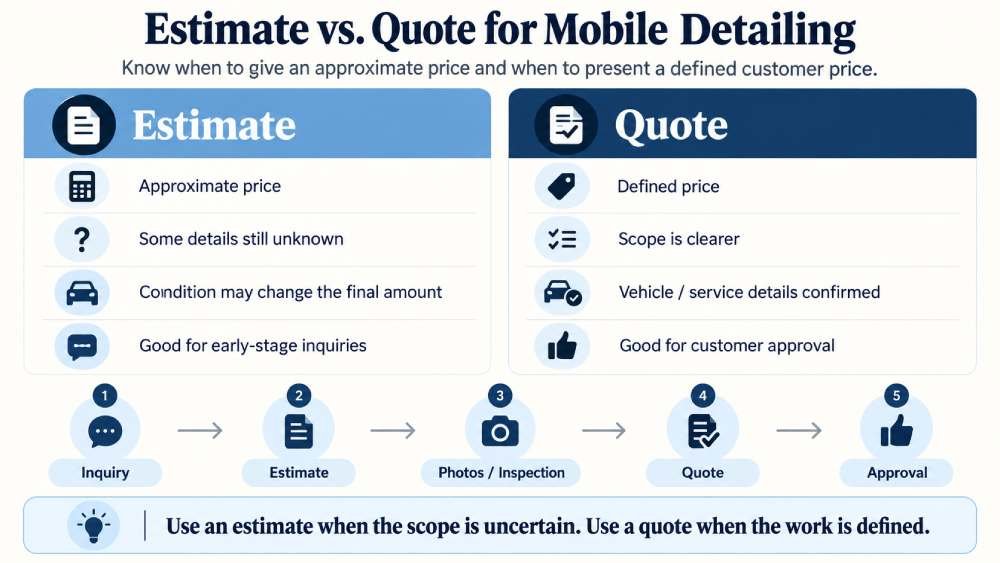
That distinction is especially useful in detailing because the service name alone rarely tells you everything about the job.
An “Interior Detail” could involve a maintained commuter vehicle or a vehicle with embedded pet hair, stains, food debris and strong odors.
If you cannot see that difference yet, an estimate may be safer than promising a firm price.
Simple rule
Uncertain scope → Estimate
Defined scope → Quote
This is a practical business distinction rather than a universal legal definition. The legal effect of the wording you use can depend on your local law, contract terms and customer agreement.
When should a mobile detailer use an estimate?
Use an estimate when you have enough information to give the customer a useful price expectation but not enough information to confidently define the final amount.
Common situations include:
- The customer has not provided clear photos
- Vehicle condition is difficult to describe remotely
- Pet hair severity is unknown
- Stains need to be inspected
- Odor severity or source is unclear
- Paint condition has not been assessed
- The customer may request additional services
- Access or service-location conditions are uncertain
An estimate can therefore communicate:
Estimated Interior Detail: $200–$250
Final price depends on vehicle condition, pet hair, staining and any additional work identified before service begins.
That gives the customer a useful range without pretending you know details you have not yet seen.
When should you give a detailing quote?
A quote makes more sense when you understand what the customer is buying and what it will take to deliver it.
For example, you may have:
- The vehicle year, make and model
- Good photos
- A clear description of the condition
- A selected package
- Defined add-ons
- A known service address
- A calculated travel fee
- A confirmed appointment scope
At that point you may be able to say:
Quoted total: $275
Includes Interior Detail, moderate pet hair removal and the agreed travel charge based on the information provided.
The key phrase is based on the agreed scope.
A quote should tell the customer what the price covers so that additional work can be treated separately rather than quietly absorbed into the original price.
Can you quote a detailing job from photos?
Sometimes.
Photos can give you useful information about:
- Vehicle size
- General interior condition
- Pet hair
- Visible staining
- Exterior contamination
- Wheel condition
- Obvious damage
But photos do not show everything.
They may not clearly reveal:
- Odors
- Embedded contamination
- How deeply stains have penetrated
- Previous treatment attempts
- Paint defects under different lighting
- Access restrictions
- Actual time required
If the photos are sufficient for the scope you are selling, you may be comfortable giving a quote.
If important uncertainty remains, give an estimate and confirm the price after seeing the vehicle.
What should a detailing estimate or quote include?
A useful document should make it easy for both you and the customer to understand the proposed job.
Include the information that affects scope, price and approval.
| Information | Why it matters |
|---|---|
| Customer details | Identifies who requested and approved the work |
| Vehicle details | Connects the price to the correct vehicle |
| Service / package | Defines the core work |
| Included work | Clarifies scope |
| Add-ons | Separates optional or condition-based work |
| Travel fee | Shows additional mobile-service cost where applicable |
| Price / estimated range | States expected customer cost |
| Deposit | Explains any booking payment requirement |
| Assumptions | Records what the price is based on |
| Validity period | Defines how long the price remains available |
| Approval | Documents the customer’s decision to proceed |
From calculation to customer approval
Calculate the job, then document the price and scope
The Mobile Detailing Operations Kit includes an editable Estimate & Quote Template plus the Pricing Calculator, Travel Fee Calculator, Client Intake Pro, Vehicle Inspection Pro and Work Order Pro.
How vehicle condition affects estimates and quotes
Vehicle condition is one of the main reasons a preliminary price may need to change.
Suppose your normal Interior Detail starts at $200.
The customer’s photos show a generally maintained interior, so you initially estimate:
When the vehicle arrives, you find deeply embedded pet hair throughout the second row and cargo area.
That condition may create an additional hour of work.
At that point you have new information.
The correct response is not to quietly absorb the extra work or surprise the customer on the final invoice.
Explain the condition, calculate the additional work and get approval for the revised price before proceeding whenever possible.
A free mobile detailing vehicle inspection form can help document the condition before work begins.
How to include detailing add-ons in an estimate or quote
Optional add-ons should normally appear as separate items so the customer understands what creates the total.
For example:
Interior Detail: $225
Pet Hair Removal: $55
Odor Treatment: $40
Quoted Total: $320
This is clearer than presenting a $320 total without explaining why the price increased.
If you have not yet published clear add-on pricing rules, see How to Price Mobile Detailing Add-ons.
Include travel fees before the customer approves the job
For mobile jobs outside your normal included area, the travel charge should be part of the expected total.
For example:
Full Detail: $300
Travel Zone 2: $20
Quoted Total: $320
That avoids presenting the travel fee as an unexpected charge later.
If you have not defined your travel policy yet, see our Mobile Detailing Travel Fees guide.
Should a detailing quote include a deposit?
If your booking policy requires a deposit, include it in the estimate or quote so the customer understands what is required to reserve the appointment.
A simple price summary might show:
| Price summary | Example |
|---|---|
| Quoted total | $300 |
| Deposit required | $50 |
| Balance after deposit | $250 |
The deposit policy itself should be clear about cancellation, rescheduling and how the payment is applied to the final invoice.
Those terms can have legal and consumer-protection implications depending on where you operate, so use wording appropriate for your jurisdiction and business.
Add a validity period to your detailing quote
Prices, availability and costs can change.
A quote issued today does not necessarily need to remain open indefinitely.
You can include wording such as:
The appropriate period depends on your business.
A validity date helps prevent an old quote from being treated as permanently available months after your pricing, schedule or service scope has changed.
Document the assumptions behind the price
An estimate or quote becomes much more useful when it records what you understood at the time.
For example:
Price assumptions
Price based on photos and information provided by the customer. Quote assumes moderate interior condition with no excessive pet hair, severe staining, biohazard contamination or undisclosed specialist treatment.
That does not give you permission to change the price arbitrarily.
It establishes what the original price was based on.
If the actual vehicle differs materially, you can explain the difference before completing additional work.
What happens when the detailing scope changes?
A customer may approve one scope and then request additional work.
Or you may discover a condition that requires more labor than expected.
Examples include:
- Adding an engine bay service
- Adding headlight restoration
- Upgrading protection
- Adding pet hair removal
- Discovering extensive staining
- Adding another vehicle
- Changing the selected package
The cleanest process is:
Scope-change workflow
Identify the change → Calculate the extra price → Explain it → Get approval → Update the job scope
Once the appointment is underway, a mobile detailing work order can help record approved changes separately from the original quote.
Example: customer requests another service after approving the quote
Suppose the original quote is:
Interior Detail: $225
Original quoted total: $225
After you arrive, the customer also asks for Engine Bay Cleaning.
You price that add-on at $50.
The revised scope becomes:
Interior Detail: $225
Approved Engine Bay Add-on: $50
Revised total: $275
The original quote was not necessarily “wrong.”
The scope changed.
Recording that difference makes the final invoice much easier to understand.
Example: turning a detailing estimate into a quote
A customer contacts you about a full interior detail on a three-row SUV.
They provide basic information but only one distant photo.
Step 1: Give an estimate
Estimated service: Full Interior Detail
Estimated range: $250–$325
Condition: Final price subject to photos or vehicle inspection.
Step 2: Collect more information
You ask the customer for photos of:
- Front seats
- Second row
- Third row
- Carpets
- Cargo area
The photos show moderate pet hair in the cargo area but no major staining.
Step 3: Calculate the actual scope
You calculate:
| Service | Price |
|---|---|
| Full Interior Detail | $260 |
| Moderate Pet Hair Add-on | $55 |
| Quoted total | $315 |
Step 4: Send the quote
You can now give a more defined $315 quote based on the photos, agreed service and stated condition.
The estimate helped the customer understand the likely range before you had enough information.
The quote came later, once the scope was clearer.
A simple estimate-to-invoice workflow for detailers
A lightweight workflow can look like this:
| Stage | Purpose |
|---|---|
| 1. Client intake | Collect customer, vehicle, condition and service information |
| 2. Estimate | Give an expected price when uncertainty remains |
| 3. Inspection / photos | Clarify vehicle condition and work required |
| 4. Quote | Define the price for the agreed scope |
| 5. Work order | Track approved work and later changes |
| 6. Invoice | Record completed work, payments and balance |
You do not need every document for every small job.
The purpose of the workflow is to add structure when the price, scope or customer expectations need it.
DetailerOffice also offers free versions of the Client Intake Form, Vehicle Inspection Form, Work Order and Invoice.
A quote is not the same thing as an invoice
A quote describes proposed work and price before the work is completed.
An invoice records what the customer owes for the completed or billable work.
| Document | Main purpose |
|---|---|
| Estimate | Approximate expected cost |
| Quote | Proposed price for a defined scope |
| Work Order | Approved job scope and changes |
| Invoice | Final charges, payments and balance due |
Common detailing estimate and quote mistakes
Calling every price a quote before seeing the vehicle
If important condition details are unknown, an estimate may communicate the uncertainty more accurately.
Giving only a total with no scope
The customer needs to know what the price includes, especially when packages and add-ons can vary.
Ignoring vehicle condition
A price based on a maintained vehicle may not work for a severely neglected vehicle requiring substantially more labor.
Leaving travel out of the initial price
If the customer is outside your included service area, show the additional travel charge before booking.
Adding unapproved work to the final invoice
If the scope changes materially, explain the additional work and get approval before proceeding whenever possible.
Giving an estimate with no assumptions
Document what information the estimate is based on so the customer understands what could change the price.
Leaving quotes open forever
A validity period helps prevent outdated prices from remaining available indefinitely.
Confusing a quote with an invoice
The quote proposes work. The invoice records what is ultimately billable.
From inquiry to final payment
Estimate the job, confirm the scope and keep every price change connected.
The Mobile Detailing Operations Kit includes the Estimate & Quote Template, Client Intake Pro, Vehicle Inspection Pro, Work Order Pro, Invoice Pro, Pricing Calculator, Travel Fee Calculator, Customer & Jobs Tracker and Quick Start Guide.
Need only a basic form? Browse our free mobile detailing business templates.
Continue building your mobile detailing pricing system
A good estimate or quote depends on the pricing system behind it.
Use the main Mobile Detailing Pricing Guide for the complete framework, How Much Should You Charge for Mobile Detailing? for complete job pricing, the Mobile Detailing Hourly Rate guide for labor, Mobile Detailing Travel Fees for mobile service costs and How to Price Mobile Detailing Add-ons for additional work.
The final guide in this pricing cluster covers:
- Mobile Detailing Profit Margin — how to distinguish job cost, markup, margin and the money left after delivering the service.
Detailing estimate vs. quote FAQs
What is the difference between a detailing estimate and a quote?
In practical business use, an estimate communicates an approximate expected price when some details remain uncertain, while a quote gives a more definite price for a defined scope of work. The legal effect of those terms can vary by jurisdiction and wording.
Should I give an estimate or quote for car detailing?
Use an estimate when vehicle condition or final scope is still uncertain. Use a quote when you have enough information to define the requested work and price with reasonable confidence.
Can I quote a detail from customer photos?
Yes when the photos and customer information give you enough detail to understand the scope. If important factors such as pet hair, stains, odor or paint condition remain uncertain, an estimate may be safer until you inspect the vehicle.
Should a detailing quote include add-ons?
Yes. List approved add-ons separately when they contribute to the total so the customer understands what additional services they are paying for.
Should a quote include the travel fee?
Yes when an additional mobile travel charge applies. Include it in the expected total before the customer confirms the appointment.
Can I change a detailing quote after the customer approves it?
If the customer requests additional work or the actual vehicle condition materially differs from the scope on which the quote was based, explain the change and get approval for the revised price before completing substantial additional work whenever possible.
Should a detailing quote have an expiration date?
It can be useful to include a validity period so the price does not remain open indefinitely after costs, availability or your service menu changes.
Should I require a deposit with a quote?
That depends on your booking policy. If you require a deposit, show the amount, how it applies to the total and any relevant booking, cancellation or rescheduling terms before the customer pays.
Is a detailing estimate legally binding?
The legal effect of an estimate, quote or customer approval depends on the jurisdiction, wording and circumstances. This guide describes practical business usage rather than providing legal advice.
What should I do if I discover extra work after starting the detail?
Explain what you found, calculate the additional cost and get customer approval before performing substantial work outside the original scope whenever possible. Record the approved change in your work order or job notes.
What comes after a detailing quote?
After approval, the job can move into a work order or service record. Once the work is completed, issue an invoice showing the final charges, payments and any remaining balance.
Use the document that matches how much you actually know
You do not need to force every customer inquiry into a firm price immediately.
If important details are still unknown, give an estimate and explain what may change it.
Once the vehicle, condition, services, add-ons and travel are sufficiently clear, turn that information into a more defined quote.
Then document any later scope changes before they become surprises on the final invoice.
That creates a cleaner pricing process for both the detailer and the customer.