Mobile detailing pricing should do more than produce a number that looks competitive. Your prices need to cover the time you spend on the job, the products you use, the cost of getting to the customer, the overhead required to keep the business running and enough profit to make the work worthwhile.
That means the best starting point is not asking what another detailer charges. It is understanding what your business needs to earn from each job and then checking whether that price makes sense in your local market.
Quick answer
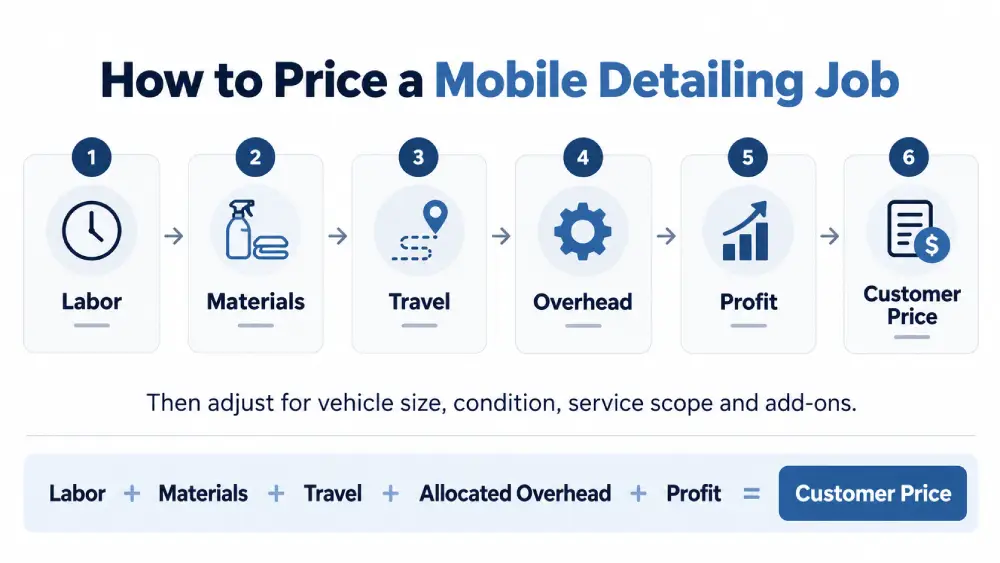
A sustainable mobile detailing price should account for labor, materials, travel, business overhead and profit — then be adjusted for the actual vehicle, condition, service scope and add-ons.
Start with a mobile detailing pricing formula
There is no single price that works for every mobile detailing business. A solo operator with low overhead, a two-person mobile crew and a shop offering mobile service may all need different prices for what looks like the same detail.
A useful way to think about your price is:
Basic pricing structure
Labor + materials + travel + allocated overhead + profit = customer price
This does not mean every quote needs to show the customer each cost separately. You can still sell simple packages such as an Interior Detail, Full Detail or Maintenance Detail. The calculation happens behind the scenes so you know whether the package price actually works.
Your published package price is the customer-facing number. Your internal pricing calculation is what tells you whether that number makes business sense.
Built for this workflow
Calculate the numbers before you send the quote
The Mobile Detailing Operations Kit includes a Pricing Calculator that combines labor, materials, travel, overhead, margin, discounts and tax, plus a separate Travel Fee Calculator for mobile jobs.
1. Calculate the value of your labor
Time is one of the largest inputs in a detailing job. Even if you charge customers a fixed package price rather than an hourly rate, you still need an internal value for your working time.
Start by estimating how many labor hours the service normally requires. Include the work that happens around the detail as well as the obvious hands-on cleaning time.
- Vehicle setup and inspection
- Exterior or interior detailing
- Equipment setup and pack-down
- Product preparation
- Customer handoff
- Job documentation
If two people work on a vehicle for two hours, that is four labor hours — not two.
An internal hourly target helps you compare jobs that look profitable on the surface but consume very different amounts of time.
A $180 job that takes two hours is very different from a $180 job that takes five hours. The selling price is identical, but the economics of the job are not.
Later in this cluster we will cover this separately in our guide to setting a mobile detailing hourly rate.
2. Add products, chemicals and consumables
Shampoo, APC, dressing, towels, pads, brushes and chemicals may look inexpensive individually, but they still need to be recovered through your pricing.
The objective is not to calculate the exact number of milliliters of product used on every vehicle. Instead, establish a realistic average product cost for each type of service and update it when your costs change.
Depending on the job, this may include:
- Cleaning chemicals
- Dressings and protectants
- Microfiber wear and replacement
- Polishing pads
- Applicators
- Gloves and disposable supplies
- Extraction chemicals
- Specialty products used for an add-on
A premium service that uses more chemicals, pads or specialty products should not carry the same product allowance as a basic maintenance service.
3. Account for mobile detailing travel costs
Mobile detailing introduces a cost that shop-based businesses do not handle in exactly the same way: you travel to the customer.
Travel is not just fuel. A job 30 minutes away can consume an hour of round-trip time before you account for mileage, parking or tolls.
A practical travel calculation can consider:
- Round-trip distance
- Fuel consumption
- Current fuel cost
- Round-trip drive time
- The value of that drive time
- Parking
- Tolls
- Other location-specific costs
You do not necessarily need to show customers a line called “drive-time cost.” Many businesses instead create a free service radius, travel zones or a minimum booking amount for distant jobs.
The important part is that travel is accounted for somewhere in the price.
We will cover this in more depth in the dedicated guide to calculating mobile detailing travel fees.
4. Include the overhead required to run the business
A detailing job can cover its chemicals and still fail to cover the business.
Overhead includes expenses that are necessary to operate but may not belong to one specific vehicle.
Examples can include:
- Insurance
- Phone and internet
- Website and software
- Advertising
- Equipment replacement
- Vehicle costs
- Licenses and business administration
- Storage
- Accounting or bookkeeping
- Payment processing
Instead of ignoring those costs, allocate a reasonable portion to your jobs. You might do this as a fixed amount per job, an hourly overhead amount or another method that reflects how your business operates.
The exact method matters less than consistently accounting for the expense.
5. Build profit into the price
Covering your costs does not automatically mean the job is profitable.
If a job costs your business $200 to deliver and you charge $200, you have recovered the cost of doing the work but created no operating profit from the job.
One useful way to calculate a target selling price is:
Target margin formula
Price = total job cost ÷ (1 − target profit margin)
For example, if your internal job cost is $170 and you are testing a 30% target margin:
$170 ÷ 0.70 = $242.86
You might then turn that calculation into a practical customer price such as $245, depending on your pricing structure and local market.
That 30% figure is only an illustration. Your actual target needs to reflect your business, expenses, capacity and goals.
Margin is not the same as markup
This distinction matters when building a pricing spreadsheet.
Markup describes how much you add to cost. Margin describes how much of the final selling price remains after the cost being measured.
If you want to manage your business using a target margin, make sure your calculator uses margin math rather than simply adding the same percentage to your costs.
6. Adjust pricing for the actual vehicle and its condition
A base package gives customers an understandable starting point. It should not force you to perform very different amounts of work for the same price.
Variables that can materially change the job include:
- Vehicle size
- Number of seating rows
- Interior condition
- Pet hair
- Sand
- Heavy staining
- Odor treatment
- Excessive debris
- Paint condition
- Access difficulty
The goal is not to create a surprise surcharge for every inconvenience. It is to define which conditions fall within the normal package and which require additional work.
This is another reason the intake and inspection process matters. The more information you collect before starting the job, the easier it is to price the work consistently.
DetailerOffice includes a free mobile detailing client intake form and vehicle inspection form if you need a more structured way to collect that information.
7. Turn your calculations into simple detailing packages
Customers usually do not want to study your internal cost structure. They want to know what the service includes and what it costs.
That is where packages become useful.
A simple service menu might be built around:
- Maintenance Detail
- Interior Detail
- Exterior Detail
- Full Detail
- Premium or correction-focused services
The names are less important than making the scope clear.
Each package should have an expected labor range, product allowance and standard scope behind it. Your calculation then tells you whether the advertised starting price still makes sense.
Use add-ons for work that is genuinely optional or variable
Add-ons can help avoid inflating every base package to cover work that only some customers need.
Examples might include:
- Pet hair removal
- Odor treatment
- Headlight restoration
- Engine bay cleaning
- Clay treatment
- Seat extraction
- Additional protection
An add-on should still be priced using the same logic: additional time + additional materials + other costs + profit.
8. Set a minimum job price
Not every small service makes sense as a standalone mobile appointment.
A 30-minute service may still require driving to the customer, setting up equipment, completing the work, packing down and driving back.
A minimum booking amount can protect your schedule from jobs that look profitable only because the hands-on service time is short.
You can also combine minimum pricing with travel zones. For example, nearby customers may qualify for your normal minimum while customers farther away need a higher minimum appointment value.
The objective is simple: make sure the entire appointment is worth taking, not just the minutes spent touching the vehicle.
Mobile detailing pricing example
Here is a simplified example of how a detailer could work backward from the real cost of a job.
| Pricing input | Example |
|---|---|
| 3.5 labor hours × $32 internal labor target | $112 |
| Products and consumables | $18 |
| Travel allocation | $15 |
| Allocated overhead | $25 |
| Internal job cost | $170 |
| Illustrative target margin | 30% |
| Calculated target price | $242.86 |
The business might round that to $245 or another practical price.
This is not a recommended market price. It is an example of how your own assumptions create a price.
Change the labor time, travel distance, material usage or overhead and the required selling price changes with them.
Use competitor pricing as a market check, not your entire pricing strategy
It still makes sense to understand what customers in your area are seeing from other detailers.
But competitor research works better as the second step.
First calculate:
- What the job costs you
- How much time it takes
- What margin you need
Then compare the result with the market.
If your calculated price is much higher than competing services, investigate why. Your costs may be high, your process may take too long, your package may include more work or you may be targeting a different customer.
If your calculated price is far below the market, do not automatically reduce it further. You may have room to improve your pricing while still offering strong customer value.
Estimates, quotes and final pricing
Not every detailing job can be priced perfectly from a short message.
When the condition of the vehicle is uncertain, make clear whether the customer is receiving an estimate, a starting price or a firm quote.
A useful quote or estimate can document:
- Customer and vehicle
- Selected service
- Included work
- Add-ons
- Price
- Travel charge if applicable
- Deposit requirements
- Assumptions about vehicle condition
- Quote validity
- Customer approval
Once work has been approved, keeping the scope organized in a mobile detailing work order can reduce confusion about what was requested, what changed and what was completed.
After the job, a consistent detailing invoice helps connect the original price to the final amount due.
Review your prices using completed jobs
Your first pricing model does not need to be perfect.
What matters is recording enough information to learn from completed jobs.
For each service, compare:
- Estimated labor time vs. actual labor time
- Expected product cost vs. actual usage
- Expected travel vs. actual travel
- Quoted price vs. final price
- Discounts given
- Add-ons sold
- Amount collected
If a package regularly takes longer than expected, the answer may be to raise the price, narrow the scope or improve the workflow.
If customers frequently request the same extra work, that may be a sign to turn it into a defined add-on or a different package.
Common mobile detailing pricing mistakes
Copying competitors without knowing your own costs
Another detailer’s price does not tell you their labor structure, travel radius, overhead or profitability.
Charging only for hands-on detailing time
Mobile work also includes travel, setup, pack-down and customer administration.
Using one price for every vehicle condition
A maintained vehicle and a neglected vehicle can require very different labor.
Ignoring small recurring costs
Consumables, payment costs, software and equipment replacement are easy to overlook because no single expense feels significant.
Confusing revenue with profit
A high-ticket job is not automatically a profitable job if it requires excessive labor, materials or travel.
Discounting without recalculating the job
A discount comes out of something. Before reducing the price, understand what it does to the profit left in the job.
Never reviewing prices
Your costs, speed, equipment and service mix will change. Your pricing system should be reviewed with them.
Turn the method into a workflow
Price the job, document it and track what happened afterward.
The Mobile Detailing Operations Kit connects pricing with the rest of the job. It includes editable intake, inspection, estimate, work order and invoice documents plus the Pricing Calculator, Travel Fee Calculator, Customer & Jobs Tracker and Quick Start Guide.
Just need a basic form? You can also browse our free mobile detailing business templates.
Continue building your mobile detailing pricing system
This guide covers the complete pricing framework. The next guides will go deeper into individual decisions:
- How Much Should You Charge for Mobile Detailing? — turning your real job costs into a practical customer price.
- Mobile Detailing Hourly Rate — how to value your working time even when customers pay a package price.
- Mobile Detailing Travel Fees — how to account for mileage, fuel and drive time.
- How to Price Detailing Add-ons — pricing optional and condition-dependent work.
- Detailing Estimate vs. Quote — when to use each one and what information to include.
- Mobile Detailing Profit Margin — understanding cost, markup, margin and the money left in a job.
Mobile detailing pricing FAQs
How should I price mobile detailing services?
Start with the labor required to complete the job, then add products and consumables, travel costs and a reasonable share of business overhead. Once you understand the internal job cost, build in your target profit and check the resulting price against your local market.
Should mobile detailers charge by the hour or by the job?
You can sell services to customers as fixed-price packages while still using an internal hourly labor target to calculate whether each package is financially worthwhile. The customer does not necessarily need to see an hourly price.
Should travel be included in mobile detailing prices?
Yes, travel needs to be recovered somewhere in your pricing. You can include normal local travel in your base prices, establish travel zones, charge a separate travel fee or use a minimum booking amount for distant jobs.
Should larger vehicles cost more to detail?
Charge more when the larger vehicle genuinely increases the work required. Vehicle size may affect labor time, product usage and access, but condition and service scope can be just as important.
How do I calculate profit margin on a detailing job?
First calculate the costs you want to measure against the job. Subtract those costs from the selling price to find the profit amount, then divide that profit by the selling price to calculate the margin percentage.
Should I copy competitors’ detailing prices?
Competitor pricing is useful for understanding your market, but it should not replace your own cost calculation. Another detailer may have different labor costs, overhead, travel requirements, equipment and business goals.
Should I charge extra for pet hair, stains or very dirty vehicles?
If those conditions create work beyond the normal scope of the package, define how you handle them before the job begins. That may mean an add-on, condition tier, revised estimate or additional approval.
How often should I review my detailing prices?
Review pricing whenever your major costs or service process changes, and periodically compare estimated job time and cost against completed jobs. The objective is to catch packages that regularly take longer or cost more than expected.
A better detailing price starts with better information
You do not need the perfect price list on day one. You need a method that lets you understand what each job costs, what your time is worth and whether the price leaves enough room for the business to operate.
Track the jobs you complete, compare your estimates with what actually happened and improve the numbers over time.
That turns pricing from guesswork into a repeatable part of running your detailing business.