A mobile detailing travel fee should cover more than the fuel used to reach the customer. Driving also consumes time, vehicle capacity and part of the working day that could otherwise be used for another job.
That does not mean every customer needs to see a separate mileage charge. You can recover travel through a free service radius, distance zones, a minimum booking amount, a flat travel fee or by building normal local travel into your package prices.
Quick answer
Calculate the complete round trip, not just the fuel.
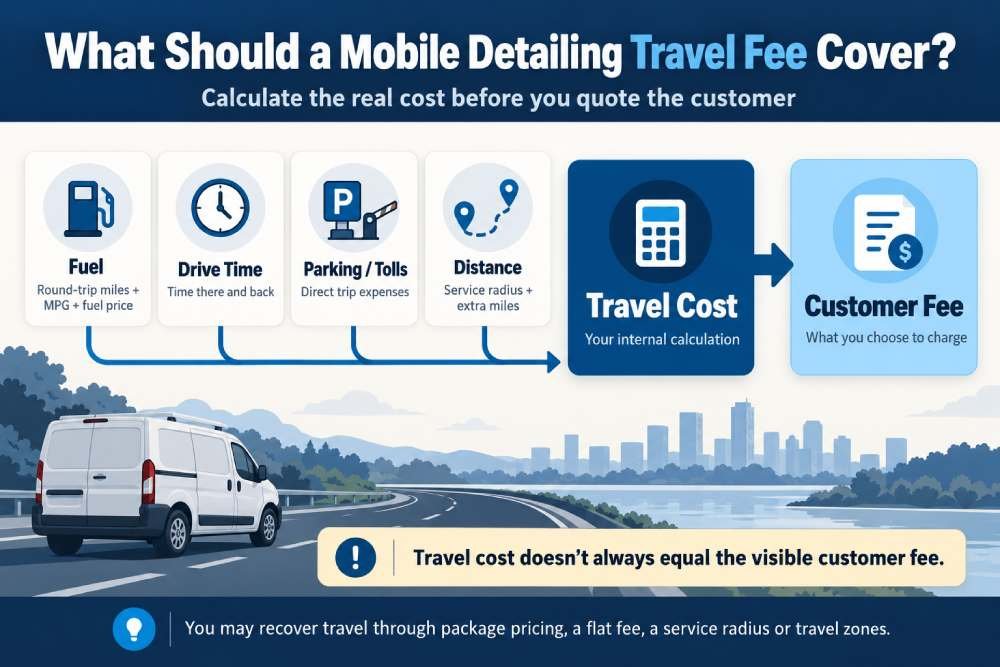
A practical mobile detailing travel calculation can include fuel, drive time, parking, tolls and other direct travel costs. Then decide how much local travel you want to absorb before charging an additional fee.
Travel is only one part of pricing a mobile detailing job. For the full framework, start with our Mobile Detailing Pricing Guide. You can also read How Much Should You Charge for Mobile Detailing? and our guide to calculating a mobile detailing hourly rate.
What should a mobile detailing travel fee cover?
The obvious travel expense is fuel, but fuel is only one part of the cost of taking your business to the customer.
Depending on the appointment, travel can include:
- Fuel
- Round-trip drive time
- Parking
- Tolls
- Other direct travel costs
- Vehicle use and wear
- Time that cannot be sold to another customer
The biggest overlooked factor is often time.
A customer may be only 20 miles away, but if traffic turns that into a 35-minute drive each way, the appointment uses more than an hour of your working day before detailing begins.
Think beyond fuel
Travel cost = vehicle cost + drive-time cost + direct travel expenses
You do not necessarily need to show those components separately to the customer. They are internal inputs that help you decide what the trip needs to produce.
Always calculate the complete round trip
If a customer is 18 miles from your base, the job does not normally create 18 miles of travel.
It creates approximately:
18 miles out + 18 miles back = 36 miles
The same principle applies to time.
A 25-minute drive to the customer generally means around 50 minutes of total travel if you return to the same area afterward.
Your actual route may differ if you schedule multiple jobs close together, but using the expected round trip gives you a safer starting point when pricing a single appointment.
How to calculate fuel cost for a mobile detailing job
A useful fuel estimate needs three pieces of information:
- Round-trip distance
- Your vehicle’s fuel economy
- The current fuel price you pay
For a vehicle measured in miles per gallon:
Fuel cost formula
Round-trip miles ÷ MPG × fuel price per gallon
Suppose:
- Round-trip distance: 40 miles
- Vehicle economy: 20 MPG
- Fuel price: $3.50 per gallon
The calculation would be:
40 ÷ 20 × $3.50 = $7.00
Fuel alone would therefore cost approximately $7 under those assumptions.
But charging $7 for the trip would ignore the time required to drive those 40 miles and any other travel-related costs.
How to value mobile detailing drive time
Drive time occupies the same calendar that you use to sell detailing work.
If you have already calculated an internal hourly revenue target, you can use that as one reference point for valuing travel time.
Suppose your internal target is:
$80 per billable hour
And the complete round trip takes:
45 minutes = 0.75 hour
At the full $80 hourly target:
0.75 × $80 = $60
That does not mean you must automatically charge the customer a $60 drive-time fee.
It tells you that the trip consumes working capacity with an internal value of approximately $60 under that model.
You can then decide how much of that travel cost is already covered by package pricing, how much falls inside your free service area and how much needs an additional fee.
Built for mobile jobs
Calculate fuel, drive time and a practical travel charge
The Mobile Detailing Operations Kit includes a dedicated Travel Fee Calculator for round-trip distance, MPG, fuel price, drive time, hourly target, parking, tolls, free travel allowance, minimum fee and markup.
A simple mobile detailing travel fee formula
You can combine the major travel inputs into one planning calculation:
Travel cost
Fuel + drive-time cost + parking + tolls + other direct travel costs
Then decide whether you want the customer-facing fee to equal the entire calculated travel cost or only the portion beyond your normal included service area.
A simplified approach might look like:
| Travel component | Example |
|---|---|
| Fuel | $6.50 |
| Drive-time cost | $32.50 |
| Parking / tolls | $5.00 |
| Estimated travel cost | $44.00 |
Your customer-facing travel charge might still be different depending on your normal service radius, minimum fee or package structure.
Create a free mobile detailing service radius
One of the simplest ways to handle local travel is to include a certain distance in your normal package price.
For example:
Customers inside that area do not see a separate travel charge.
Customers beyond it may pay an additional fee.
This approach can make pricing easier to communicate while still protecting you from long-distance appointments.
How large should your free service radius be?
There is no universal answer.
Think about:
- Traffic in your area
- Typical driving speeds
- Where most customers are located
- Your vehicle’s operating cost
- Your minimum job price
- Average appointment value
- How tightly you can schedule jobs geographically
A 10-mile radius in a rural area can behave very differently from a 10-mile radius in heavy city traffic.
Time matters as much as distance.
Use travel zones when one service radius is too simple
Travel zones can work well when your customers are spread across a wider area.
Instead of calculating a custom fee for every address, establish simple bands.
| Distance from base | Example policy |
|---|---|
| 0–10 miles | Included |
| 11–20 miles | Fixed Zone 2 travel fee |
| 21–30 miles | Higher Zone 3 travel fee |
| 30+ miles | Custom quote or minimum booking requirement |
The dollar amounts behind those zones should come from your own travel economics.
The example is a structure, not a recommended fee schedule.
Why zones can work better than a per-mile charge
Customers often understand:
“Travel within 10 miles is included. Your location falls in our $20 travel zone.”
more easily than:
“Your location is 17.4 miles away, so we multiplied the additional mileage by a custom rate.”
Travel zones trade some mathematical precision for simplicity.
Flat travel fee vs. per-mile fee
Both methods can work, but they solve slightly different problems.
| Method | Best use | Trade-off |
|---|---|---|
| Flat fee | Simple service areas or travel zones | Less precise for unusual trips |
| Per-mile fee | Variable distances or custom quotes | Can be harder to explain and may ignore traffic time |
A per-mile fee should not automatically be treated as the complete travel cost.
Mileage measures distance. It does not directly measure how long the journey takes.
Ten miles of highway driving and ten miles of city traffic can consume very different amounts of time.
Use a minimum booking amount for longer trips
Sometimes the best solution is not a larger travel fee.
It is a larger job.
Suppose a distant customer wants a $75 standalone service, but reaching the location requires more than an hour of total travel.
A separate travel charge large enough to make that appointment worthwhile may look disproportionate to the service itself.
Instead, you might establish:
Locations outside the standard service area require a minimum booking value.
The customer can then combine services or choose a larger package.
This allows the business to recover the travel cost through a higher-value appointment instead of attaching a large fee to a very small service.
You do not always need a separate travel fee
A visible travel charge is only one way to recover travel costs.
You might choose not to show a separate fee when:
- Most customers are within a compact area
- Normal travel is already built into package prices
- You schedule multiple jobs in the same area
- Your minimum job price comfortably absorbs local travel
- A separate fee would add unnecessary friction to quoting
The important question is not:
“Do I charge a travel fee?”
It is:
“Where does my travel cost get recovered?”
If the answer is “nowhere,” your mobile service area may be quietly reducing your margins.
Mobile detailing travel fee example
Suppose a customer books a mobile detail 12 miles from your base.
Your assumptions are:
- Round-trip distance: 24 miles
- Vehicle fuel economy: 22 MPG
- Fuel price: $3.60 per gallon
- Total drive time: 48 minutes
- Internal hourly target: $65
- Parking and tolls: $0
- Free travel allowance: first 10 miles of distance
Step 1: Calculate fuel
24 ÷ 22 × $3.60 = $3.93
Step 2: Calculate drive-time cost
Forty-eight minutes equals 0.8 hour.
0.8 × $65 = $52.00
Step 3: Calculate total travel cost
$3.93 + $52.00 = $55.93
Under this simplified model, the complete trip creates approximately $55.93 of travel cost or working-capacity value.
That does not automatically become a $55.93 customer fee.
Part of the trip may already be included in your normal service radius or package pricing.
You can then calculate the portion beyond your included area and decide on a practical fee.
| Travel calculation | Example |
|---|---|
| Fuel | $3.93 |
| Drive-time cost | $52.00 |
| Estimated travel cost | $55.93 |
| Example customer travel charge | $20.00 |
| Travel cost absorbed elsewhere | $35.93 |
That last row is important.
If you charge only $20, the remaining travel economics need to be recovered through the package price, minimum booking, route efficiency or another part of your business model.
Compare the travel cost with the value of the job
The same journey may make sense for one appointment and not another.
For example:
| Appointment | Job value | Travel decision |
|---|---|---|
| Small standalone service | $80 | May need minimum booking or larger travel fee |
| Full detail | $300 | Travel may be easier to absorb partly in package pricing |
| Multi-vehicle booking | $550 | One trip generates revenue from multiple services |
This is why a travel policy can include both distance and minimum appointment value.
Grouping nearby jobs can reduce travel cost per customer
Your travel economics improve when one trip supports more than one paid job.
If you drive 30 minutes to an area for one customer and immediately return home afterward, that entire round trip belongs to one appointment.
If you complete three nearby jobs before returning, the same outbound and return journey supports considerably more revenue.
That is one reason geographic scheduling can improve profitability without changing customer prices.
You might:
- Group customers by neighborhood
- Offer certain areas on specific days
- Encourage multi-vehicle household bookings
- Schedule fleet or workplace jobs together
- Reduce unnecessary back-and-forth driving
How to explain a travel fee to customers
Travel fees are easier to accept when the policy is simple and communicated before the appointment.
Instead of explaining fuel formulas, drive-time calculations and overhead, give the customer a clear rule.
For example:
Example customer wording
Mobile service is included within our standard service area. Locations outside that area may require an additional travel fee based on distance.
Or:
Example zone wording
Travel within 10 miles is included. Appointments outside the included area are quoted with the applicable travel zone before booking.
The customer needs the policy and the final fee.
They do not need your entire internal cost calculation.
Include the travel charge in the estimate before the job
Avoid surprising the customer with a travel fee after completing the detail.
When you know the service location, include any additional travel charge in the quoted or estimated amount.
A simple breakdown might look like:
Full Interior Detail: $225
Travel Zone 2: $20
Estimated total: $245
This gives the customer the full expected price before accepting the appointment.
Common mobile detailing travel-fee mistakes
Charging only for fuel
Fuel may be a small part of the real cost. Drive time can be substantially more valuable than the gasoline used.
Calculating one-way mileage
Unless another paid job changes the route, the trip normally includes getting back as well.
Using distance without considering traffic
A short urban trip can consume more time than a much longer highway journey.
Having no free-travel policy
Without a defined normal service area, similar customers may receive inconsistent travel charges.
Driving long distances for very small jobs
A minimum booking amount can sometimes work better than adding a large travel fee to a low-value service.
Hiding the travel fee until the invoice
Additional travel costs should be communicated before the customer approves the job whenever possible.
Copying another detailer’s mileage charge
Their vehicle, traffic, service radius, hourly target and scheduling efficiency may be different from yours.
Never reviewing the policy
Fuel prices, vehicle costs, traffic patterns and your customer base change. Your travel rules can change with them.
Stop guessing at travel charges
Calculate the trip before you quote the customer.
The Mobile Detailing Operations Kit includes a Travel Fee Calculator for distance, MPG, fuel price, drive time, hourly target, parking, tolls, free travel allowance, minimum fee and markup, plus the Pricing Calculator and the rest of the job workflow.
Need business forms instead? Browse our free mobile detailing templates.
Continue building your mobile detailing pricing system
Travel fees work best as part of a complete pricing model rather than as an isolated surcharge.
Start with the main Mobile Detailing Pricing Guide, then use How Much Should You Charge for Mobile Detailing? to build the complete job price and our Mobile Detailing Hourly Rate guide to value your working time.
Upcoming guides will cover:
- How to Price Detailing Add-ons — pricing additional labor, products and condition-dependent work.
- Detailing Estimate vs. Quote — deciding when the customer price should be preliminary or firm.
- Mobile Detailing Profit Margin — understanding cost, markup, margin and the amount left in the job.
Mobile detailing travel fee FAQs
Should mobile detailers charge a travel fee?
Travel needs to be recovered somewhere, but it does not always need to appear as a separate fee. You can include normal travel in package pricing, establish a free service radius, use travel zones, charge a distance fee or require a larger minimum booking for distant appointments.
How much should I charge for mobile detailing travel?
There is no universal travel fee. Calculate your round-trip fuel cost, drive time and direct expenses such as parking or tolls, then decide how much travel is already included in your normal service area and how much needs to be charged separately.
Should I charge per mile for mobile detailing?
You can, but mileage alone does not reflect drive time. Ten miles in heavy traffic may cost more working capacity than a longer highway trip. A zone-based or blended travel policy can sometimes be easier to use.
Should I charge for both directions?
Your internal calculation should normally consider the complete expected trip, including the return journey, unless another paid appointment changes the route.
Should fuel be the only travel cost?
No. Fuel may be one of the smallest parts of a mobile trip. Driving also consumes working time, and some appointments may include parking, tolls or other direct costs.
What is a mobile detailing service radius?
A service radius is an area around your normal operating location in which travel is included in the standard price. Customers outside the included area may receive an additional travel fee, different minimum booking requirement or custom quote.
How large should my free service radius be?
Base it on your actual geography, traffic, customer density, vehicle costs and appointment values rather than copying another detailer. Distance and driving time should both influence the decision.
Is a flat travel fee better than charging per mile?
A flat fee or travel zone is easier for customers to understand, while per-mile pricing can be more precise for unusual distances. The better method is the one that consistently recovers your travel economics without making quoting unnecessarily complicated.
Can I use a minimum booking instead of a travel fee?
Yes. For distant locations, requiring a higher appointment value can sometimes make more sense than adding a large travel charge to a small service.
When should I tell the customer about the travel fee?
Before the appointment is confirmed whenever possible. Include the travel charge in the estimate or quote so the customer understands the expected total price before approving the job.
A travel fee should protect the job, not complicate the sale
The purpose of a travel policy is not to charge customers for every mile you drive.
It is to make sure your mobile service area does not quietly turn otherwise profitable jobs into poor appointments.
Calculate what travel actually costs, decide what normal local travel your package prices can absorb, and create a simple rule for the distance beyond that area.
That can be a free radius, travel zones, a flat fee, a per-mile charge, a minimum booking requirement or a combination of those approaches.
The exact structure can vary. The important part is that the travel cost is intentional instead of forgotten.