Mobile detailing add-ons can increase the value of a job without forcing every customer into a larger package. The challenge is deciding what should count as an add-on and what the additional work should actually cost.
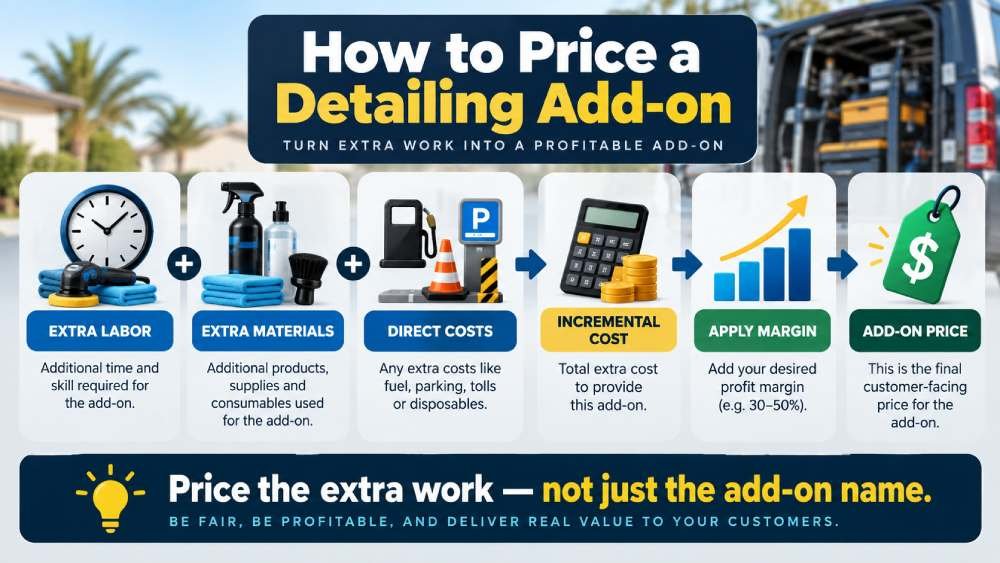
Instead of choosing an arbitrary fee for pet hair, stains, odor treatment or an engine bay, calculate the additional labor, materials and direct costs created by that work, then price it using the same profit logic as the rest of the job.
Quick answer
Price the additional work, not the name of the add-on.
Estimate the extra labor, products and direct costs required beyond the normal package scope. Calculate the incremental job cost, then apply the same margin or pricing method you use for the rest of your detailing services.
Add-ons are one part of the larger pricing system. Start with our Mobile Detailing Pricing Guide, then see How Much Should You Charge for Mobile Detailing?, our Mobile Detailing Hourly Rate guide and the guide to Mobile Detailing Travel Fees.
What should count as a mobile detailing add-on?
An add-on should represent work that is genuinely outside the standard scope of the package or work that only some customers need.
That distinction matters.
If every Interior Detail requires basic vacuuming, vacuuming should probably be included in the package rather than sold as an add-on.
But if one vehicle has deeply embedded pet hair that adds an hour of specialized removal work, that additional labor may reasonably sit outside the normal package price.
Useful distinction
Base package = expected work
Add-on = optional or additional work beyond that normal scope
A clear package scope prevents customers from feeling as though they are being charged extra for basic work they assumed was included.
A simple formula for pricing detailing add-ons
Start by calculating what the extra work costs your business.
Step 1 — Incremental add-on cost
Extra labor + extra materials + other direct costs
Then convert that cost into a customer price using the same margin logic you use elsewhere.
Step 2 — Customer add-on price
Incremental add-on cost ÷ (1 − target margin)
For example, if additional work creates $35 of incremental cost and you are testing a 30% target margin:
$35 ÷ 0.70 = $50
That gives an illustrative customer price of $50 for that additional work.
The percentage is only an example. Use the pricing method that matches your own business model.
Calculate the extra labor before choosing the add-on price
Labor is often the largest cost behind a detailing add-on.
Suppose your internal labor value is $40 per hour.
If a particular add-on normally requires 45 minutes of additional work:
0.75 hour × $40 = $30 labor allocation
If another vehicle requires 90 minutes for the same type of problem:
1.5 hours × $40 = $60 labor allocation
That is why the same add-on name does not always justify the same price.
The amount of work can vary significantly.
Add extra products and direct costs
Some add-ons consume substantially more product than the base service.
Depending on the work, that might include:
- Specialty stain chemicals
- Odor-treatment products
- Extraction solution
- Additional microfiber use
- Polishing pads
- Compound or polish
- Trim-restoration products
- Protection products
- Special applicators
- Disposable supplies
You do not need to calculate every milliliter used on every vehicle.
Instead, develop reasonable product allowances based on completed jobs.
Price the extra work before adding it to the quote
Test labor, materials and margin instead of guessing at add-on prices
The Mobile Detailing Operations Kit includes a Pricing Calculator for labor, materials, travel, overhead, margin, discounts and tax, plus an Estimate & Quote Template for presenting the final job scope to the customer.
Fixed-price vs. variable detailing add-ons
Not every add-on needs the same pricing structure.
Some services are predictable enough to use a fixed price.
Others depend heavily on the condition of the vehicle.
| Pricing type | Best suited for | Example |
|---|---|---|
| Fixed price | Predictable scope and labor | Simple engine bay cleaning |
| Starting at | Work with moderate condition variation | Pet hair removal |
| Custom quote | Highly variable or specialist work | Severe odor or extensive correction |
The pricing structure should reflect how predictable the work is.
A simple fixed number works well when the labor range is narrow. A condition-based price is safer when one vehicle may take three times as long as another.
How to price pet hair removal
Pet hair is a good example of why condition-dependent work can be difficult to price with one universal fee.
A few loose hairs on a leather seat may require almost no additional time.
Heavy hair embedded throughout carpet, seat fabric and cargo areas can add substantial labor.
A simple condition structure might be:
| Condition | Pricing approach |
|---|---|
| Light | May fit inside normal package labor |
| Moderate | Add a defined labor allowance |
| Heavy | Quote based on estimated removal time after photos or inspection |
Pet hair pricing example
Suppose moderate pet hair adds approximately 45 minutes to the job.
Using an illustrative $40 internal labor value:
0.75 × $40 = $30 labor
Add $3 of extra supplies:
$30 + $3 = $33 incremental cost
At an illustrative 30% target margin:
$33 ÷ 0.70 = $47.14
You might turn that into a practical $45 or $50 add-on depending on your pricing structure.
Again, the important part is the process, not the example number.
How to price stain removal and extraction work
Stain treatment becomes an add-on when it requires work beyond what your normal interior package includes.
That might mean:
- Additional pre-treatment
- Agitation
- Extraction
- Multiple passes
- Specialty chemicals
- Extra drying or setup time
Do not promise that every stain can be removed simply because the customer buys the add-on.
Your price is for performing the agreed treatment, not guaranteeing a perfect result when the outcome depends on material, stain type, age and previous cleaning attempts.
Price the process you can control
For example:
| Extra work | Example |
|---|---|
| Additional labor | 0.5 hr |
| Labor allocation at $40/hr | $20 |
| Extra chemicals | $6 |
| Incremental cost before margin | $26 |
How to price odor treatment
Odor treatment should be priced according to the process required rather than simply using one “odor removal” fee.
Different odor problems may require different combinations of:
- Source identification
- Vacuuming and cleaning
- Extraction
- Targeted chemical treatment
- Ventilation-system work
- Specialized equipment
- Additional treatment time
- A follow-up visit
A mild food odor and a severe smoke-related problem are not equivalent jobs.
For more variable odor work, a starting price or custom quote may be safer than a single fixed fee.
How to price engine bay cleaning
Engine bay cleaning can be easier to standardize because the normal service scope may be more predictable.
Your calculation can include:
- Setup and inspection time
- Cleaning and agitation
- Products and brushes
- Drying
- Dressing where appropriate
- Cleanup time
Suppose the service normally adds 30 minutes and $4 of product cost.
At a $40 internal labor allocation:
0.5 × $40 = $20 labor
Then:
$20 labor + $4 materials = $24 incremental cost
You would then apply your normal pricing or margin method to determine the customer-facing add-on price.
Other mobile detailing add-ons you can price with the same method
The same calculation works across many optional services.
| Add-on | Main pricing inputs |
|---|---|
| Headlight restoration | Labor, abrasives, compounds, protection |
| Clay treatment | Vehicle size, contamination, labor, clay/media, lubricant |
| Trim restoration | Surface area, preparation, product, application time |
| Seat extraction | Seat count, condition, chemicals, extraction time |
| Protection upgrade | Product cost, preparation, application and curing workflow |
| Paint correction | Paint condition, test spot, labor, pads, compounds and correction goal |
The service name changes. The pricing logic does not.
Use photos or an inspection before pricing condition-based add-ons
Pet hair, stains, odors and neglected interiors are difficult to price accurately from a short message such as:
Ask for enough information to understand the scope.
That can include:
- Vehicle make and model
- Photos of the affected areas
- Approximate severity
- How long the condition has existed
- Previous treatment attempts
- Customer expectations
DetailerOffice has a free mobile detailing client intake form and vehicle inspection form if you need a more structured process.
Use pricing tiers when the condition varies predictably
For some add-ons, tiers can make quoting faster.
For example:
| Tier | Typical scope |
|---|---|
| Light | Small amount of additional work with predictable labor |
| Moderate | More extensive work requiring a larger labor allowance |
| Heavy | Significant condition requiring custom assessment or quote |
Do not create tiers only because they look professional on a menu.
Build them after enough real jobs show you what “light,” “moderate” and “heavy” normally mean in terms of labor.
Complete mobile detailing add-on pricing example
Suppose a customer books an Interior Detail, then sends photos showing moderate pet hair throughout the rear seats and cargo area.
You estimate:
| Add-on input | Example |
|---|---|
| Additional labor | 1 hour |
| Internal labor value | $40/hour |
| Labor allocation | $40 |
| Additional products / supplies | $5 |
| Incremental add-on cost | $45 |
| Illustrative target margin | 30% |
| Calculated add-on price | $64.29 |
You might turn that into a practical customer-facing add-on of approximately $65.
Now imagine a different vehicle with only 15 minutes of light pet hair removal.
Charging the same $65 without checking the scope could overprice that vehicle.
And a vehicle requiring two hours of embedded pet hair removal could be significantly underpriced at $65.
The add-on name is the same. The work is not.
Sometimes the better solution is a higher package, not another add-on
If customers regularly need several add-ons together, your package structure may need attention.
Suppose many customers buy:
- Interior Detail
- Seat extraction
- Pet hair removal
- Odor treatment
That combination may be better presented as a higher-level restoration or deep-interior package rather than four separate line items.
Add-ons should make the service menu clearer, not turn every quote into a complicated list of micro-charges.
How to present detailing add-ons to customers
Customers should understand three things:
- What the base package includes
- What the additional service includes
- What the approved total will be
For optional upgrades, you can present the add-on directly:
Engine Bay Cleaning — $XX add-on
For condition-dependent work, make the conditional nature clear:
Pet Hair Removal — priced after reviewing vehicle condition and estimated additional labor.
The customer does not need to see your internal hourly cost or margin calculation.
They need a clear scope and a clear price before the additional work begins.
Get approval before adding work during the job
Sometimes an add-on only becomes necessary after you begin the detail.
For example, inspection may reveal heavier contamination, deeper staining or another issue that was not visible in the original photos.
Do not simply complete substantial extra work and add it to the invoice afterward.
Explain what you found, state the additional price and obtain customer approval before proceeding whenever possible.
A mobile detailing work order can help document the approved scope and later changes.
Common mistakes when pricing detailing add-ons
Copying another detailer’s add-on menu
Their labor rate, process, products and package inclusions may be different from yours.
Using one price for every condition
A little pet hair and two hours of embedded pet hair are not the same job.
Charging extra for work customers reasonably expect in the base package
This creates confusion and can make your service menu feel misleading.
Ignoring extra product cost
Specialty chemicals, pads, extraction solution and protection products can materially change the economics of an add-on.
Ignoring setup and cleanup time
A 20-minute treatment may still require equipment preparation, cleaning and pack-down.
Promising results you cannot guarantee
Price the treatment process, especially for stains and odors where the final result may depend on factors outside your control.
Performing unapproved work
If the scope changes, communicate the additional price before continuing whenever possible.
Creating too many add-ons
If the menu becomes difficult to understand, combine related work into clearer packages or higher service tiers.
Price the extra work before the customer approves it
Calculate the add-on, update the quote and keep the final job organized.
The Mobile Detailing Operations Kit includes the Pricing Calculator, Estimate & Quote Template, Client Intake Pro, Vehicle Inspection Pro, Work Order Pro, Invoice Pro, Travel Fee Calculator, Customer & Jobs Tracker and Quick Start Guide.
Need only a basic document? Browse our free mobile detailing business templates.
Continue building your mobile detailing pricing system
Add-on pricing becomes much easier when the base pricing system is already clear.
Use the main Mobile Detailing Pricing Guide for the complete framework, How Much Should You Charge for Mobile Detailing? for complete job pricing, the Mobile Detailing Hourly Rate guide for labor and Mobile Detailing Travel Fees for distance and drive-time pricing.
The remaining guides in this cluster cover:
- Detailing Estimate vs. Quote — deciding when a customer price should be preliminary or firm.
- Mobile Detailing Profit Margin — understanding job cost, selling price, markup and margin.
Mobile detailing add-on pricing FAQs
What should count as a detailing add-on?
Use an add-on for optional work or work that falls clearly outside the expected scope of the base package. Services that almost every customer needs should generally be considered when building the package itself.
How do I calculate the price of a detailing add-on?
Estimate the extra labor, materials and other direct costs created by the additional work. Calculate the incremental job cost, then apply the same pricing or margin method you use for your core services.
How much should I charge for pet hair removal?
Base the price on severity and additional labor rather than using one universal fee. Light pet hair may fit within the normal service, while embedded hair throughout carpet and upholstery can require substantial additional time.
Should I charge extra for stains?
Charge extra when stain treatment requires work beyond the normal package scope, such as specialty chemicals, extraction or significant additional labor. Make clear that the price covers the treatment process rather than guaranteeing complete stain removal.
Should odor removal be a fixed-price add-on?
Only when the process and expected labor are predictable. Odor problems vary significantly by source and severity, so more complex cases may be better priced with a starting price or custom quote.
How should I price engine bay cleaning?
Estimate the additional setup, cleaning, drying and dressing time plus product usage and other direct costs. If the service has a predictable scope, it may work well as a fixed-price add-on.
Should add-ons have different prices for SUVs?
Only when vehicle size creates meaningful additional work or product usage. An add-on that requires twice the surface area or substantially more labor on a larger vehicle should reflect that difference.
Should I use “starting at” pricing for add-ons?
It can work well for condition-dependent services where the minimum scope is predictable but more severe vehicles require additional labor. State clearly that the final price depends on condition.
Should I get customer approval before adding an extra service?
Yes, whenever possible. Explain the additional work, provide the revised price and obtain approval before completing substantial work outside the original scope.
How many add-ons should a detailing menu have?
There is no ideal number. Keep add-ons for services that customers genuinely choose separately or that vary by condition. If the menu becomes difficult to understand, combine related work into packages or service tiers.
A good add-on price starts with the extra work
You do not need to know what every detailer charges for pet hair, stains or engine bay cleaning.
You need to know what the additional service requires from your business.
Estimate the extra labor. Account for the extra materials and direct costs. Apply your normal pricing logic. Then communicate the scope and price before the work begins.
That creates add-on prices that are easier to explain, easier to update and much less dependent on guesswork.