Your mobile detailing hourly rate does not have to be a number you advertise to customers. It can be an internal pricing tool that tells you how much each labor hour needs to produce for the business.
Even if you sell an Interior Detail for a fixed price, you still need to know whether two, four or six hours of labor make that package worthwhile.
Quick answer
Calculate an internal hourly target even if customers never pay you by the hour.
Your hourly target should reflect the compensation you want from the business, operating overhead, realistic billable hours and the profit you want the business to retain. Then use that number to test package prices and individual jobs.
This guide focuses specifically on the value of your labor time. For the complete pricing system, see our Mobile Detailing Pricing Guide. If you are trying to turn these numbers into actual service prices, also read How Much Should You Charge for Mobile Detailing?.
What does a mobile detailing hourly rate actually mean?
There are two different numbers that detailers sometimes describe as an hourly rate.
The first is a customer-facing hourly price. This means telling the customer that detailing costs a certain amount per hour.
The second is an internal hourly target. This is a planning number used behind the scenes to decide whether your service prices are high enough.
For most package-based detailing businesses, the second number is more useful.
Internal pricing question
How much revenue does each billable labor hour need to produce?
Once you know that number, you can test almost any detailing package.
If your internal target is $80 per labor hour and a package normally requires four labor hours, you immediately know that the labor component alone needs to support approximately $320 of revenue before considering whether certain materials, travel or other job-specific costs should be added separately.
That does not automatically mean the customer should see “4 hours × $80.” It is simply your internal calculation.
Internal hourly target vs. charging customers by the hour
You can use an hourly calculation without selling hourly labor.
This distinction matters because fixed-price packages are often easier for customers to understand.
| Pricing method | How it works |
|---|---|
| Customer hourly pricing | The customer pays according to time spent on the job. |
| Internal hourly target | You use labor hours internally to calculate whether a fixed package price works. |
A detailer might therefore advertise:
Full Interior Detail — from $249
Behind the scenes, the business may know that the job normally takes three labor hours and compare the $249 selling price with its internal hourly target and other job costs.
The customer sees a clear service and price. The business still has a measurable way to evaluate the job.
How to calculate your mobile detailing hourly target
A useful planning method is to estimate how much money the business needs to generate during the year and divide that amount by the number of hours you realistically expect to sell.
Owner-operator planning formula
(Owner compensation target + operating overhead + business profit target) ÷ annual billable labor hours
This gives you an approximate revenue target for each billable labor hour.
It is a pricing-planning formula, not an accounting or tax classification. How owner compensation and profit are treated for accounting purposes depends on your business structure and jurisdiction.
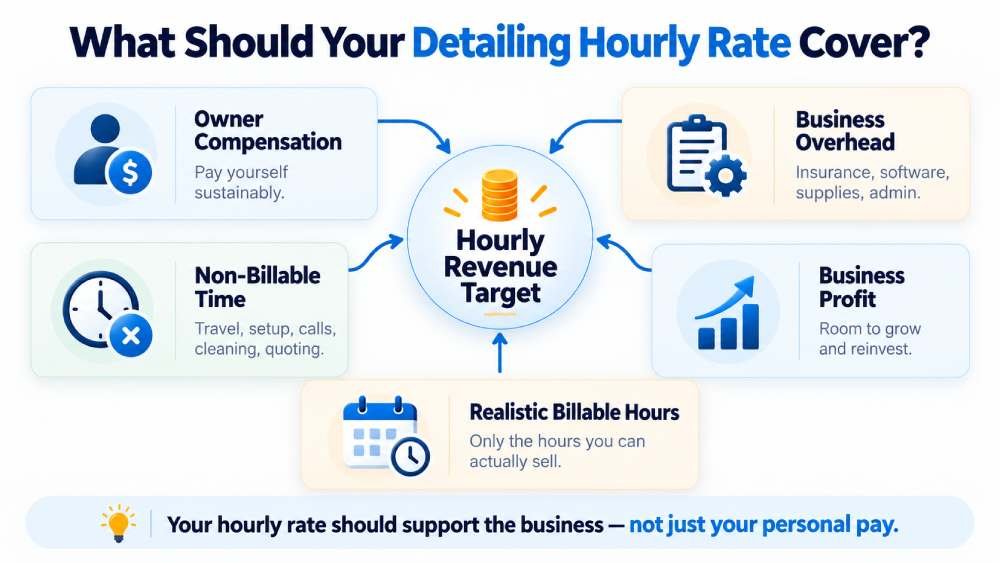
Do not divide by every hour you work
One of the easiest ways to underestimate your hourly target is to assume that every working hour can be billed to a customer.
It cannot.
A mobile detailer also spends time on:
- Driving between jobs
- Quoting customers
- Answering messages
- Scheduling
- Ordering products
- Cleaning equipment
- Bookkeeping
- Marketing
- Vehicle maintenance
- Rescheduling appointments
- Administrative work
Those hours still exist even though no customer receives an invoice for them.
Example: working 40 hours does not mean billing 40 hours
Suppose you work approximately 40 hours during a week but only spend 25 hours completing billable detailing work.
| Weekly activity | Hours |
|---|---|
| Billable detailing work | 25 |
| Travel and setup | 6 |
| Quotes and customer communication | 4 |
| Admin, maintenance and other work | 5 |
If you divide your annual income goal by 40 hours per week when only 25 are realistically billable, your pricing model can start too low.
Test the hourly target inside a real job
See what your labor time does to the final customer price
The Mobile Detailing Operations Kit includes a Pricing Calculator that combines your hourly target with estimated labor hours, materials, travel, overhead, margin, discounts and tax.
Your hourly target should support the income you want from the business
If you are a solo owner-operator, your labor is not free simply because you own the business.
Your pricing model should consider the level of compensation you want the business to support.
Suppose your target is to generate $60,000 per year for your own compensation from the business.
If you expect approximately 1,000 billable detailing hours during the year:
$60,000 ÷ 1,000 billable hours = $60 per billable hour
But that $60 only addresses the compensation target in this simplified example.
The business may still need to recover insurance, software, advertising, vehicle costs, equipment replacement and other overhead.
And if you want the business itself to retain profit beyond your compensation target, that also needs to be considered.
Add business overhead to the calculation
Your detailing hourly rate should not be based only on what you want to earn personally.
The business has expenses even when no vehicle is being detailed.
Typical overhead can include:
- Business insurance
- Vehicle costs
- Phone and internet
- Website hosting
- Booking or CRM software
- Advertising
- Storage
- Equipment replacement
- Accounting
- Licensing
- Payment processing costs
Suppose annual operating overhead is approximately $24,000.
With 1,000 billable labor hours:
$24,000 ÷ 1,000 = $24 overhead per billable hour
Using the previous compensation example:
| Hourly requirement | Example |
|---|---|
| Owner compensation allocation | $60 |
| Overhead allocation | $24 |
| Subtotal before additional business profit | $84/hour |
That already shows why setting a $40 or $50 hourly target simply because it “sounds fair” can be misleading.
Owner compensation and business profit are not the same planning goal
It is useful to separate what you want to earn for your work from what you want the business to retain.
If every dollar remaining after overhead is treated as your compensation, the business may have little room for:
- Future equipment purchases
- Vehicle replacement
- Slow periods
- Unexpected repairs
- Hiring
- Marketing investment
- Expansion
For pricing purposes, you can therefore add a business profit target on top of compensation and overhead.
For example:
| Annual planning target | Example |
|---|---|
| Owner compensation target | $60,000 |
| Operating overhead | $24,000 |
| Additional business profit target | $18,000 |
| Required annual revenue before job-specific costs | $102,000 |
With 1,000 billable labor hours:
$102,000 ÷ 1,000 = $102 per billable labor hour
Again, this is an illustrative planning example — not a recommendation that every mobile detailer should target $102 per hour.
How hourly-rate calculations change when you have employees
When employees perform the detailing work, their wage is only one part of the labor cost.
Depending on your location and business structure, direct labor may also involve employer payroll taxes, insurance, benefits, paid time and other labor-related costs.
For internal pricing, a simplified structure might look like:
Employee labor cost
Wage + employer labor burden + overhead allocation + required profit
Do not assume that paying an employee $20 per hour means labor costs the business only $20 per hour.
The employee may also have non-billable time for setup, driving, training, equipment maintenance or gaps between appointments.
Count labor hours, not just appointment hours
This becomes especially important when more than one person works on a vehicle.
If a two-person crew completes a detail in three clock hours:
2 workers × 3 hours = 6 labor hours
A $300 job may therefore look very different depending on whether:
- One person completes it in three hours, or
- Two people complete it in three hours.
The appointment duration may be identical from the customer’s perspective, but the business consumed twice as many labor hours in the second scenario.
Mobile detailing hourly rate example
Here is a complete simplified example for a solo mobile detailer.
| Planning input | Example |
|---|---|
| Desired annual owner compensation | $60,000 |
| Annual overhead | $24,000 |
| Business profit target | $18,000 |
| Annual revenue requirement | $102,000 |
| Expected annual billable hours | 1,000 |
| Internal hourly revenue target | $102/hour |
Now suppose a full detail requires approximately four labor hours.
4 × $102 = $408
That gives you a starting revenue requirement associated with those four billable hours under this particular model.
You would then consider how your model handles job-specific costs such as unusually high product usage, long-distance travel, tolls or special add-ons.
The point is not that a full detail should cost $408. The point is that the price is now connected to a measurable business model rather than a guess.
Charging $50 per hour does not mean you earn $50 per hour
This distinction causes a lot of pricing confusion.
Suppose a detailer prices labor around $50 per billable hour.
Part of that revenue may need to cover:
- Insurance
- Fuel and vehicle costs
- Marketing
- Equipment
- Software
- Unbillable working time
- Business profit
What remains personally available to the owner may therefore be much less than $50.
How to use your hourly target with fixed-price packages
Once you have an internal hourly target, you can test every package against it.
Suppose your internal target is $90 per billable labor hour.
| Package | Price | Labor hours | Revenue per labor hour |
|---|---|---|---|
| Package A | $180 | 2 | $90 |
| Package B | $225 | 3.5 | $64.29 |
| Package C | $360 | 4 | $90 |
Package B immediately deserves attention.
That does not automatically mean the package is bad. There may be strategic reasons for its price or different cost assumptions.
But now you know where to investigate.
You could:
- Raise the price
- Reduce the included scope
- Improve the process
- Turn certain work into add-ons
- Use condition-based pricing
Calculate your effective hourly revenue after the job
Before the job, you have an estimated labor time.
After the job, you have the actual labor time.
That makes it possible to calculate the effective hourly revenue:
Effective hourly revenue
Customer price ÷ actual labor hours
For example:
$280 job ÷ 4 hours = $70/hour
If you originally expected the job to take three hours:
$280 ÷ 3 hours = $93.33/hour
That extra hour changed the economics of the job substantially.
This is why tracking actual labor time can be more useful than relying on memory.
Improve your hourly economics without only raising prices
Increasing your customer price is not the only way to improve hourly performance.
You can also reduce unnecessary time.
Examples include:
- Better equipment organization
- Preparing chemicals before leaving
- Reducing unnecessary trips to the vehicle
- Improving customer intake
- Confirming access before arrival
- Grouping jobs geographically
- Creating repeatable detailing processes
- Using clear service scopes
If the same service falls from four hours to three hours without reducing quality, the effective hourly revenue increases even if the selling price stays exactly the same.
Travel time needs its own decision
For mobile detailers, one question is whether driving time should be included inside the hourly target or recovered separately.
Both models can work.
You might:
- Include normal local travel in package pricing
- Charge a separate travel fee
- Use a free service radius
- Create distance zones
- Set higher minimum bookings for distant customers
What matters is that the business recovers the cost of traveling to customers somewhere in the model.
The next guide in this cluster will cover mobile detailing travel fees in detail.
When should your mobile detailing hourly target increase?
Your internal hourly target should change when the economics of the business change.
Review it when:
- Insurance or vehicle expenses increase
- Product and equipment costs increase
- You hire employees
- Your desired compensation changes
- You have fewer billable hours than expected
- Your business becomes consistently booked
- You invest in better equipment or systems
- Your services become more specialized
- Your current packages no longer support your financial goals
Do not assume that the hourly target you calculated when starting the business should remain unchanged indefinitely.
Turn the hourly target into a customer price
Calculate labor, materials, travel, overhead and margin before you quote the job.
The Mobile Detailing Operations Kit includes a Pricing Calculator, Travel Fee Calculator, Estimate & Quote Template, Client Intake Pro, Vehicle Inspection Pro, Work Order Pro, Invoice Pro, Customer & Jobs Tracker and Quick Start Guide.
Need a basic document instead? Browse our free mobile detailing business templates.
Continue building your mobile detailing pricing system
Your hourly target is only one part of the final customer price.
Use the main Mobile Detailing Pricing Guide for the full framework, or review How Much Should You Charge for Mobile Detailing? to see how labor, vehicle condition, travel and other factors come together in individual jobs.
Upcoming guides will cover:
- Mobile Detailing Travel Fees — how to recover fuel, mileage and drive time.
- How to Price Detailing Add-ons — turning additional labor and products into consistent add-on prices.
- Detailing Estimate vs. Quote — deciding when a price should be preliminary or firm.
- Mobile Detailing Profit Margin — understanding the relationship between costs, price, markup and margin.
Mobile detailing hourly rate FAQs
How much should a mobile detailer charge per hour?
There is no universal hourly rate that fits every mobile detailing business. Calculate how much revenue each billable labor hour needs to produce based on your compensation goals, operating overhead, realistic billable hours and business profit goals, then compare the result with your market.
Do mobile detailers normally charge by the hour?
They do not have to. A mobile detailer can sell fixed-price packages while using an internal hourly target to calculate whether those package prices support the business.
What is an internal hourly rate?
An internal hourly rate or hourly target is a business-planning number that estimates how much revenue each billable labor hour needs to generate. Customers do not necessarily see this number.
Should my hourly rate include overhead?
Your pricing needs to recover overhead somewhere. Allocating annual overhead across realistic billable hours is one way to understand how much each hour needs to contribute toward business expenses.
Should travel time count toward my detailing hourly rate?
Travel needs to be recovered somewhere, but you can structure it in different ways. Some businesses include normal travel in package prices, while others use travel fees, service zones or minimum booking amounts.
How do I calculate billable hours?
Estimate the hours you realistically expect to spend completing customer-paid detailing work. Do not automatically count every working hour, because quoting, driving, marketing, administration and equipment maintenance may not be directly billable.
Does a $100 hourly rate mean the detailer earns $100 per hour?
No. Revenue per labor hour may still need to cover overhead, non-billable working time, equipment, vehicle costs and business profit. The amount personally available to the owner can be much lower.
How do I calculate the effective hourly rate of a job?
Divide the final customer price by the actual labor hours used. For example, a $300 job requiring four labor hours produces $75 of revenue per labor hour before considering how that revenue is allocated.
Should two workers double the labor hours?
Yes for internal labor calculations. If two people each work three hours on the vehicle, the business used six labor hours even though the appointment lasted only three clock hours.
When should I raise my hourly target?
Review it when your overhead changes, labor costs rise, your expected billable hours change, you add employees, your compensation goal changes or existing package prices no longer support your business targets.
Your hourly rate is a measuring tool, not just a price tag
You do not need to put an hourly price on your website for an hourly target to be useful.
Knowing what each labor hour needs to produce gives you a way to evaluate packages, compare jobs and identify services that consume more time than their price supports.
Start with realistic billable hours, include the costs and financial goals of the business, and then compare that target with what your completed jobs actually produce.
That turns your hourly rate from a guess into a practical pricing benchmark.