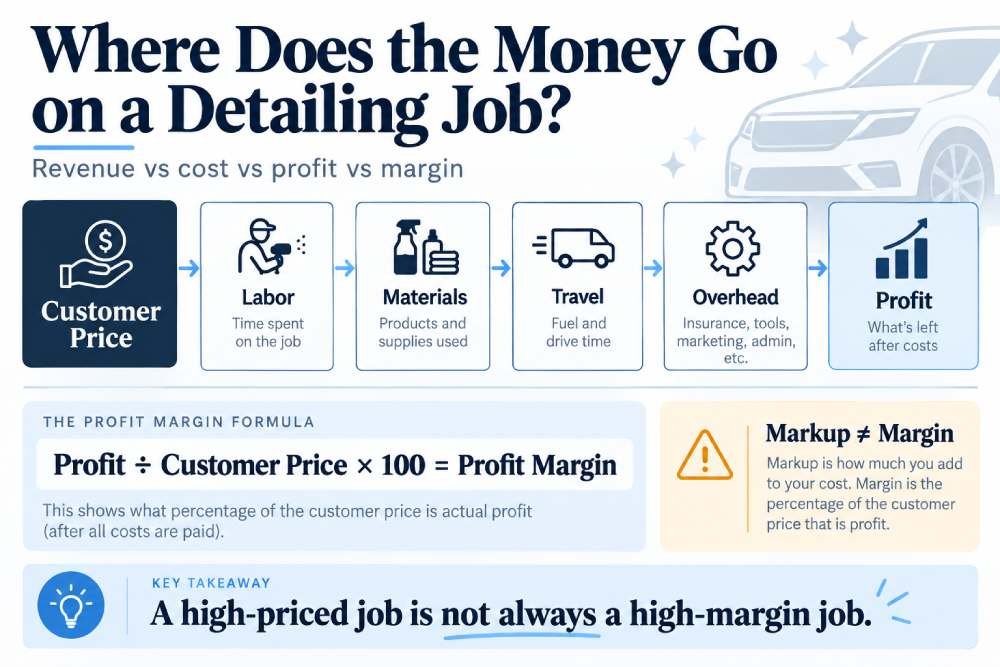
A mobile detailing job can bring in good revenue and still leave very little profit. The customer price is only the top-line number. What matters is how much remains after the labor, products, travel and other costs required to complete the work.
Understanding your mobile detailing profit margin gives you a practical way to compare jobs, review packages and spot services that look attractive on the surface but consume too much time or cost.
Quick answer
Profit is what remains after the costs you assign to the job. Profit margin shows that amount as a percentage of the customer price.
Do not choose a margin target simply because another detailer uses it. Your labor structure, overhead, travel, service mix, capacity and business goals may be different.
This guide closes our mobile detailing pricing system. If you are building your prices from scratch, start with the Mobile Detailing Pricing Guide. You can also review How Much Should You Charge for Mobile Detailing?, the Mobile Detailing Hourly Rate guide, Mobile Detailing Travel Fees, How to Price Mobile Detailing Add-ons and Detailing Estimate vs. Quote.
Revenue is not the same as profit
If a customer pays $300 for a detail, the business generated $300 of revenue from that job.
That does not mean the business made $300.
The job may have required:
- Several hours of labor
- Cleaning chemicals and consumables
- Travel
- Equipment use
- An allocation of business overhead
A simple way to think about the job is:
Job profit
Customer price − job cost = profit
Suppose:
$300 customer price − $210 job cost = $90 profit
Under that simplified model, $90 remains above the costs assigned to the job.
How to calculate mobile detailing profit margin
Profit margin expresses the profit amount as a percentage of the selling price.
Profit margin formula
Profit margin % = profit ÷ customer price × 100
Using the $300 job with $90 of profit:
$90 ÷ $300 × 100 = 30%
The job has a 30% margin under the cost model being used.
This is why it is important to define what you include in job cost. If you leave out labor, travel or overhead, the calculated margin can look much healthier than the real economics of the work.
Markup and margin are not the same thing
This is one of the most common pricing mistakes.
Markup compares profit with cost.
Margin compares profit with the final selling price.
| Metric | Formula |
|---|---|
| Markup % | Profit ÷ Cost × 100 |
| Margin % | Profit ÷ Selling Price × 100 |
Example: $100 cost and $130 selling price
Profit:
$130 − $100 = $30
Markup:
$30 ÷ $100 = 30% markup
Margin:
$30 ÷ $130 = 23.1% margin
Markup vs. margin examples
The difference becomes easier to see when the numbers are placed side by side.
| Cost | Selling price | Profit | Markup | Margin |
|---|---|---|---|---|
| $100 | $120 | $20 | 20% | 16.7% |
| $100 | $130 | $30 | 30% | 23.1% |
| $100 | $150 | $50 | 50% | 33.3% |
| $100 | $200 | $100 | 100% | 50% |
If you are trying to target a specific margin, use margin math rather than simply adding that percentage to your job cost.
How to calculate a price from your target margin
Once you know the internal job cost and have a target margin you want to test, you can calculate the required selling price.
Target-margin pricing formula
Customer price = job cost ÷ (1 − target margin)
Suppose your estimated job cost is $210 and you are testing a 30% target margin:
$210 ÷ 0.70 = $300
At a $300 selling price:
$300 − $210 = $90 profit
And:
$90 ÷ $300 = 30% margin
That is different from simply adding 30% to $210.
A 30% markup would produce:
$210 × 1.30 = $273
At $273, the profit is $63 and the resulting margin is approximately 23.1%.
See the margin before you send the price
Calculate job cost, recommended price and estimated gross profit
The Mobile Detailing Operations Kit includes a Pricing Calculator for labor, materials, travel, overhead, target margin, discounts and tax, plus the Customer & Jobs Tracker for reviewing completed jobs and revenue.
What should you include in a detailing job cost?
Your profit calculation is only as useful as the cost calculation behind it.
If you count products but ignore labor and travel, the job may appear much more profitable than it actually is.
For internal planning, a job-cost model can include:
- Labor
- Products and consumables
- Travel
- Parking and tolls
- Job-specific supplies
- An allocated share of business overhead
The exact categories depend on how you run the business.
The important part is consistency.
If you include overhead in one service but not another, comparing their margins becomes misleading.
Labor time can destroy the margin on an otherwise good-looking job
Consider a $300 detailing job.
You originally expect the work to take three hours.
If your internal labor allocation is $45 per hour:
3 × $45 = $135 labor
But imagine the vehicle takes five hours instead:
5 × $45 = $225 labor
The selling price did not change.
The labor cost increased by $90.
That $90 comes directly out of what would otherwise have remained in the job.
Our Mobile Detailing Hourly Rate guide explains how to give your labor time a measurable internal value.
Travel can reduce mobile detailing profit quickly
Mobile work introduces a cost that shop-based services do not handle in exactly the same way.
Two customers may buy the same $250 package, but one may be five minutes away while the other requires an hour of total driving.
If that additional trip creates $40 of travel cost or working-capacity value:
| Customer | Price | Additional travel cost |
|---|---|---|
| Nearby customer | $250 | $5 |
| Distant customer | $250 | $40 |
The revenue is identical. The economics are not.
That is why travel should be recovered through package pricing, a service radius, travel fee, minimum booking or another deliberate pricing rule.
See our Mobile Detailing Travel Fees guide for a complete travel-cost framework.
Products matter, but do not focus on chemicals while ignoring time
Detailers often notice the cost of chemicals because those expenses are visible.
But saving $2 on product does little for profitability if a job requires an unexpected extra hour of labor.
Suppose:
- Product cost increases by $5
- Unexpected labor increases by $45
The labor difference has nine times the financial effect in this example.
Track materials, but keep the larger cost drivers in perspective.
Discounts can reduce profit faster than they reduce the customer price
Suppose a job sells for $300 and costs $210 to deliver.
Profit:
$300 − $210 = $90
Margin:
$90 ÷ $300 = 30%
Now offer a $30 discount.
New customer price:
$270
The job still costs $210.
Profit becomes:
$270 − $210 = $60
New margin:
$60 ÷ $270 = 22.2%
The customer price fell by 10%, but the profit amount fell from $90 to $60 — a reduction of one-third.
Well-priced add-ons can improve the economics of a job
Add-ons can increase appointment value without repeating all of the costs associated with acquiring and traveling to another customer.
For example, you are already at the customer’s location completing a Full Detail.
The customer adds an Engine Bay Cleaning service.
The extra work may require:
- 30 additional minutes
- A few dollars of product
- No additional customer acquisition
- No second round trip
If priced correctly, that add-on can improve the total economics of the appointment.
But the same rule still applies: price the extra work rather than choosing an arbitrary number.
See How to Price Mobile Detailing Add-ons for the complete method.
Complete mobile detailing profit margin example
Suppose you quote a Full Detail for $350.
Your estimated costs are:
| Job input | Example |
|---|---|
| Labor | $160 |
| Products / consumables | $25 |
| Travel | $20 |
| Allocated overhead | $35 |
| Estimated job cost | $240 |
| Customer price | $350 |
| Estimated profit | $110 |
Margin:
$110 ÷ $350 × 100 = 31.4%
Under these assumptions, the job produces an estimated 31.4% margin.
Now imagine the job takes one additional hour
If that extra hour adds $40 to your labor allocation:
New job cost = $280
Profit:
$350 − $280 = $70
Margin:
$70 ÷ $350 × 100 = 20%
One additional hour reduced the margin from approximately 31.4% to 20%.
That is why estimating and tracking labor accurately matters so much.
Profit margin and effective hourly revenue answer different questions
Margin tells you what percentage of the selling price remains above the costs included in your model.
Effective hourly revenue tells you how much revenue the job generated per labor hour.
Effective hourly revenue
Customer price ÷ actual labor hours
Suppose the $350 job required four labor hours:
$350 ÷ 4 = $87.50 per labor hour
If it required six hours:
$350 ÷ 6 = $58.33 per labor hour
The selling price is identical. The productivity of the job is very different.
Looking at both margin and effective hourly revenue gives you more context than either number alone.
Compare profit margins across detailing packages
One of the most useful applications of job-level margin is comparing services.
Imagine three packages:
| Package | Price | Job cost | Profit | Margin |
|---|---|---|---|---|
| Package A | $150 | $105 | $45 | 30% |
| Package B | $250 | $205 | $45 | 18% |
| Package C | $350 | $227.50 | $122.50 | 35% |
Package B generates more revenue than Package A but leaves the same $45 profit amount and a much lower margin.
That is exactly the kind of issue you can miss when judging services only by selling price.
What is a good profit margin for a mobile detailing business?
There is no single percentage that every mobile detailing business should target.
A useful margin depends on factors such as:
- Your labor structure
- Owner compensation
- Employee costs
- Service mix
- Business overhead
- Travel area
- Pricing position
- Customer acquisition cost
- Capacity
- Growth plans
A solo detailer operating from a low-overhead setup may have very different economics from a multi-vehicle operation with employees, storage, advertising and administrative costs.
Instead of asking:
“What margin should every detailer have?”
ask:
“What margin does my business need after correctly accounting for its costs?”
Then compare that target with your actual completed jobs.
A target margin is a planning benchmark, not a guarantee
A pricing calculator may tell you that a job should sell for $300 to achieve a particular target margin.
That does not guarantee the job will actually achieve that margin.
Actual results can change because:
- The job takes longer than estimated
- More product is used
- The customer location changes
- Unexpected travel occurs
- A discount is applied
- Additional work is completed without being charged
That is why there are two useful stages:
| Stage | Purpose |
|---|---|
| Before the job | Estimate price and target margin |
| After the job | Compare actual time, cost and final revenue |
How to improve mobile detailing job profitability
Improving profit does not always mean simply raising every price.
You have several levers.
1. Improve pricing
Raise prices when the current selling price no longer supports the labor, costs and target margin of the service.
2. Reduce unnecessary labor time
Better equipment organization, customer intake, service processes and setup can reduce job time without lowering service quality.
3. Charge for additional scope
Pet hair, stains, specialist treatments and optional upgrades should not quietly expand the package without a pricing decision.
4. Improve travel efficiency
Use service areas, travel zones and geographic scheduling to reduce time spent driving between customers.
5. Increase average appointment value
Relevant add-ons, multi-vehicle bookings and appropriately structured packages can make one trip produce more revenue.
6. Review discounts
Measure what each discount does to the profit amount before using it as a routine sales tactic.
7. Review packages that repeatedly run long
If a package frequently takes more time than expected, change the price, scope or workflow rather than accepting the problem indefinitely.
Track completed detailing jobs to find your real margins
Estimated margins are useful before the appointment.
Completed-job data is what tells you whether your assumptions were accurate.
For each job, consider tracking:
- Customer
- Service / package
- Quoted price
- Final price
- Labor time
- Travel
- Add-ons
- Discounts
- Amount paid
- Outstanding balance
If you also track the cost assumptions behind your services, you can identify patterns such as:
- A package that regularly takes too long
- A travel area that produces weak jobs
- An add-on that is underpriced
- A service with strong margins
- Discounts that remove too much profit
You do not need sophisticated business intelligence software to start learning from your jobs. Consistent records are already a major improvement over memory alone.
Protect the margin by defining the scope before the job starts
Profitability becomes harder to control when the job scope is vague.
If you quote a standard Interior Detail but the customer expects pet hair removal, stain extraction and odor treatment at the same price, the job can expand while the revenue stays fixed.
A clear estimate or quote helps define:
- What is included
- What is excluded
- Which add-ons are approved
- Any travel fee
- The expected customer total
See Detailing Estimate vs. Quote for a complete workflow.
Common mobile detailing profit-margin mistakes
Confusing revenue with profit
A $400 job is not a $400 profit. Revenue must first cover the costs assigned to delivering the work.
Confusing markup with margin
Adding 30% to cost creates a 30% markup, not a 30% margin.
Leaving labor out of job cost
Owner labor still has economic value even when the owner does not receive a traditional hourly paycheck.
Ignoring non-billable work
Quotes, scheduling, equipment cleaning, administration and other work still affect the overall economics of the business.
Ignoring travel
A distant customer may buy the same package but produce a very different result after drive time and vehicle costs.
Using the same cost assumptions forever
Product prices, fuel, labor, equipment and overhead change over time.
Discounting based only on the selling price
A 10% discount can remove much more than 10% of the profit left in the job.
Never checking actual job time
If your pricing assumes three hours but the job repeatedly takes five, your margin estimate is based on the wrong input.
Chasing one margin percentage across every service
Different services may have different strategic value, capacity requirements and cost structures. Use margin as a decision tool rather than a rigid rule disconnected from the rest of the business.
Know what the job leaves behind
Price the job with margin in mind, then track what actually happened.
The Mobile Detailing Operations Kit includes the Pricing Calculator for job cost, recommended price, estimated gross profit and effective hourly revenue, plus the Customer & Jobs Tracker, Travel Fee Calculator, Estimate & Quote Template, Work Order Pro, Invoice Pro and the rest of the operating workflow.
Need a basic document instead? Browse our free mobile detailing business templates.
Mobile detailing pricing: complete guide series
This article completes the DetailerOffice mobile detailing pricing cluster. Use the guides below depending on the pricing decision you are working on:
- Mobile Detailing Pricing Guide — the complete framework for labor, materials, travel, overhead and profit.
- How Much Should You Charge for Mobile Detailing? — turn real job costs into a practical customer price.
- Mobile Detailing Hourly Rate — understand what each labor hour needs to produce.
- Mobile Detailing Travel Fees — account for fuel, distance and drive time.
- How to Price Mobile Detailing Add-ons — price additional labor, products and condition-dependent work.
- Detailing Estimate vs. Quote — decide when a customer price should be preliminary or firm.
Mobile detailing profit margin FAQs
How do I calculate profit on a mobile detailing job?
Subtract the costs assigned to delivering the job from the final customer price. For example, if a job sells for $300 and your job-cost model totals $210, the profit amount under that model is $90.
How do I calculate detailing profit margin?
Divide the profit amount by the customer selling price and multiply by 100. A $300 job with $90 of profit has a 30% margin.
What is the difference between markup and margin?
Markup compares profit with cost, while margin compares profit with selling price. If a service costs $100 and sells for $130, it has a 30% markup but approximately a 23.1% margin.
What is a good profit margin for mobile detailing?
There is no universal target that works for every detailing business. A suitable margin depends on labor, overhead, travel, service mix, business structure, capacity and financial goals. Calculate your own costs first and use a target that makes sense for your operation.
Should labor be included when calculating detailing profit?
For job-pricing purposes, labor should have an economic value even when the owner performs the work. Ignoring owner labor can make a job look more profitable than it really is.
Should overhead be included in job cost?
The business needs to recover overhead somewhere. Allocating a reasonable share of expenses such as insurance, software, equipment and administration to jobs is one way to incorporate those costs into pricing decisions.
How does travel affect mobile detailing profit?
Travel consumes fuel, vehicle use and working time. A distant appointment can therefore have a lower profit than a nearby job sold at the same price unless travel is recovered through package pricing, fees, zones or minimum bookings.
How do discounts affect detailing profit margin?
Discounts reduce the selling price while many job costs remain unchanged. As a result, the percentage reduction in profit can be much larger than the percentage discount given to the customer.
Can a high-priced detailing job still have a low margin?
Yes. A high selling price does not guarantee strong profitability if the job requires extensive labor, expensive products, long-distance travel or other significant costs.
How can I improve profit without raising every price?
Improve workflow efficiency, reduce avoidable labor, charge appropriately for add-ons, manage travel, increase appointment value, reduce unnecessary discounting and review packages that consistently take longer than expected.
Should every detailing service have the same profit margin?
Not necessarily. Different services can have different labor requirements, strategic value and capacity constraints. Margin is useful for comparison, but it should be evaluated alongside job time, revenue, demand and the overall business model.
How often should I review detailing margins?
Review them periodically and whenever major cost or pricing inputs change. Comparing estimated figures with completed jobs is especially useful for identifying services that regularly take longer or cost more than expected.
A profitable job starts before the vehicle is detailed
Profit is not something you discover only after the customer pays.
It begins with understanding the expected labor, materials, travel and overhead before you set the customer price.
Then the completed job tells you whether those assumptions were right.
Track the difference between what you expected and what actually happened. Adjust packages that repeatedly run long. Charge for additional scope. Review travel. Understand what discounts remove from the job.
That turns profit margin from an abstract percentage into a practical tool for running a stronger detailing business.