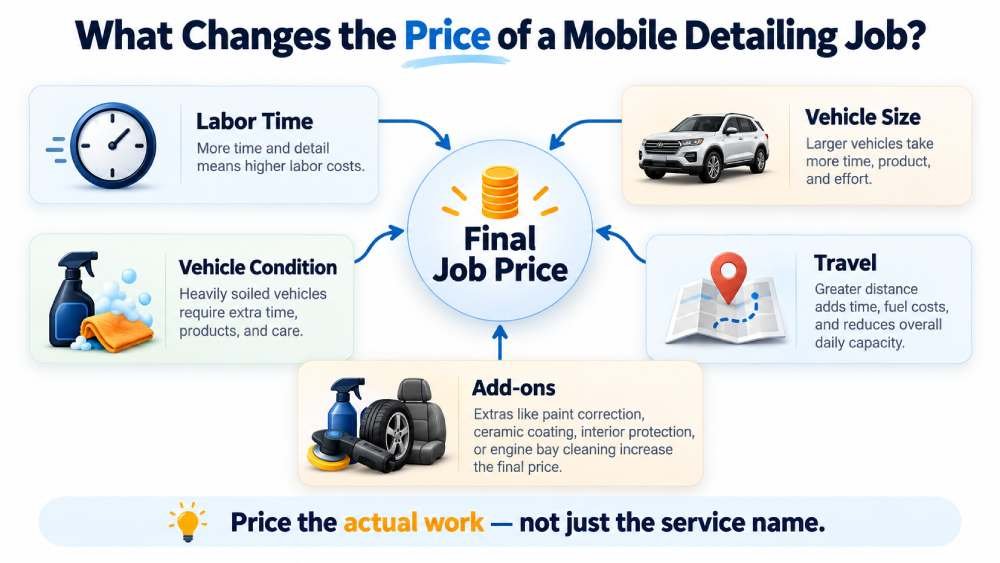
How much you should charge for mobile detailing depends on more than the service name. Two jobs both sold as a “full detail” can require very different amounts of labor, products, travel and preparation.
A better way to set your price is to calculate what the job will actually require, add the profit you want the business to make, and then compare that number with what customers in your market are willing to pay.
Quick answer
Do not choose your mobile detailing price from the service name alone.
Estimate the labor required, products and consumables, travel, allocated overhead and desired profit. Then adjust for vehicle size, condition, add-ons and the actual scope of work.
This page focuses specifically on deciding how much to charge. For the complete pricing framework — including labor, travel, overhead, margin, packages and estimates — start with our mobile detailing pricing guide.
How to calculate what to charge for a mobile detailing job
A simple starting point is to calculate the internal cost of completing the job and then convert that cost into a customer price.
Step 1 — Calculate job cost
Labor + materials + travel + allocated overhead = internal job cost
Once you know the internal job cost, you can build profit into the customer price.
Step 2 — Build in your target margin
Customer price = internal job cost ÷ (1 − target margin)
For example, imagine a job costs you approximately $170 after accounting for labor, products, travel and overhead.
If you were testing a 30% target margin:
$170 ÷ 0.70 = $242.86
You might turn that into a practical customer-facing price such as $245.
That does not mean $245 is the correct market price for that service. It means $245 is the price produced by those particular business assumptions.
Mobile detailing pricing examples
The examples below show how different jobs can produce different customer prices when you calculate the work behind them.
These are illustrative planning examples, not recommended prices or national averages.
| Example service | Labor | Job cost | Example price |
|---|---|---|---|
| Maintenance detail | 1.5 hrs | $87.50 | $120 |
| Interior detail | 3 hrs | $157 | $225 |
| Exterior detail | 2.5 hrs | $134.50 | $195 |
| Full detail | 4.5 hrs | $227.50 | $325 |
The value of the exercise is not memorizing $120, $225 or $325. It is understanding why a job produces that price.
Calculate your own price
Replace the example numbers with your actual business costs
The Mobile Detailing Operations Kit includes a Pricing Calculator for labor, materials, travel, overhead, margin, discounts and tax, plus a separate Travel Fee Calculator.
Start with how long the job will actually take
Labor is usually the biggest reason one detailing job should cost more than another.
A service that sounds simple can become unprofitable when the actual appointment takes twice as long as expected.
Estimate the total labor required for:
- Vehicle inspection
- Equipment setup
- Interior or exterior detailing
- Special treatments
- Pack-down
- Customer handoff
- Basic job administration
If two detailers work on the same vehicle for three hours, the business used six labor hours.
That matters even if the customer only sees a fixed package price.
Use an internal hourly target
You do not need to sell your services by the hour to value your time internally.
Suppose your internal labor target is $35 per labor hour.
| Labor required | Internal labor value |
|---|---|
| 1.5 labor hours | $52.50 |
| 3 labor hours | $105 |
| 4.5 labor hours | $157.50 |
| 6 labor hours | $210 |
Your own hourly target may be higher or lower. The important part is giving your working time a measurable value.
Charge more when vehicle size creates more work
A larger vehicle should not automatically cost more just because it has a different badge or body style. It should cost more when its size increases the amount of work required.
A three-row SUV may mean:
- More carpet and upholstery
- More glass
- Additional seats
- More interior panels
- More exterior surface area
- Longer vacuuming and extraction time
- Greater product usage
Instead of choosing an arbitrary SUV surcharge, estimate how much additional labor and product the larger vehicle normally requires.
If a sedan interior typically takes 2.5 hours but a three-row SUV regularly takes 3.5 hours, price the additional hour of work rather than simply guessing at a larger-vehicle fee.
Vehicle condition can matter more than vehicle size
Two identical vehicles can require completely different amounts of work.
A maintained SUV may be easier to detail than a neglected compact car.
Condition-related work can include:
- Heavy pet hair
- Sand
- Food debris
- Excessive trash
- Heavy staining
- Odor treatment
- Embedded dirt
- Tree sap
- Heavy bug contamination
- Neglected wheels
- More intensive paint preparation
The question is not whether the vehicle looks “dirty.” The question is whether its condition creates meaningful additional labor, materials or specialist work beyond the package scope.
Collect condition information before promising a final price
Photos, customer intake and a vehicle inspection can make pricing much more consistent.
If you need a basic workflow, DetailerOffice has a free mobile detailing client intake form and vehicle inspection form.
Do not use one flat surcharge for every difficult vehicle
A $25 “dirty vehicle fee” may make sense for one job and be completely inadequate for another.
A better approach is to translate the additional condition into additional work.
| Condition | Pricing question |
|---|---|
| Light pet hair | Can it be handled within the normal package time? |
| Heavy pet hair | How much additional labor will removal require? |
| Staining | Does treatment require extraction, chemicals and extra drying time? |
| Heavy debris | How much additional preparation and disposal time is needed? |
| Strong odors | Is a separate treatment or follow-up process required? |
When the condition cannot be assessed accurately before arrival, make it clear that the initial price is a starting estimate rather than a guaranteed final quote.
Do not forget that mobile detailing includes travel
A customer 25 miles away may buy the same service as a customer five minutes away, but the two appointments do not cost your business the same amount.
Travel can involve:
- Fuel
- Vehicle wear
- Round-trip drive time
- Parking
- Tolls
- Time that cannot be sold to another customer
You can recover those costs in several ways.
Option 1: Include normal travel in your base price
This can work when most customers fall within a small, predictable service area.
Option 2: Create a free service radius
Customers within the normal radius pay the standard price. Longer trips trigger an additional fee.
Option 3: Create travel zones
For example, you might establish different booking rules for nearby, medium-distance and distant appointments.
Option 4: Use a higher minimum booking amount
Instead of charging a visible travel fee, you can require a larger appointment value for distant jobs.
Price detailing add-ons based on the extra work they create
Add-ons are useful because they let you keep the base package simple without giving away labor-intensive extras.
Common examples include:
- Pet hair removal
- Odor treatment
- Headlight restoration
- Engine bay cleaning
- Seat extraction
- Clay treatment
- Additional protection
- Trim restoration
- Special stain treatment
The same pricing principle applies:
Add-on pricing
Extra labor + extra materials + other costs + profit
Avoid choosing an add-on price simply because another detailer lists that number online.
Their process, time and cost structure may be completely different from yours.
Set a minimum mobile detailing job price
Some services are too small to make financial sense as individual mobile appointments.
Imagine a customer wants a small service that takes only 30 minutes on the vehicle.
The complete appointment might still require:
- 25 minutes driving to the customer
- 10 minutes setting up
- 30 minutes performing the service
- 10 minutes packing down
- 25 minutes driving back
A 30-minute service has now occupied around 100 minutes of your schedule.
That is why a minimum appointment price can be more useful than pricing every small task independently.
Your minimum should reflect the complete appointment
Consider:
- Minimum labor you need to recover
- Normal travel
- Setup and pack-down
- Consumables
- Overhead
- Profit
You can then use that minimum as the floor below which a standalone mobile appointment does not make sense.
Example: pricing a mobile interior detail
Suppose a customer requests an interior detail on a midsize vehicle.
After reviewing photos and the requested service, you estimate:
| Pricing input | Example |
|---|---|
| 3 labor hours × $35 | $105 |
| Products and consumables | $18 |
| Travel allocation | $12 |
| Allocated overhead | $22 |
| Internal job cost | $157 |
| Illustrative target margin | 30% |
| Calculated target price | $224.29 |
You could turn that calculation into a customer-facing price of approximately $225.
Now imagine the customer sends additional photos showing extensive pet hair.
You estimate that removal will add another 45 minutes of labor and some additional product usage.
Instead of absorbing that extra work into the original $225 price, calculate the additional cost and revise the estimate before the appointment.
This is how condition-based pricing becomes consistent rather than arbitrary.
Do not promise a firm price before you understand the job
Some jobs can be priced immediately. Others cannot.
A maintenance detail for a repeat customer may be predictable enough for a fixed package price.
A neglected vehicle with unknown stains, pet hair and odor may require an estimate first.
Before committing to the final price, try to establish:
- Vehicle type and size
- Current condition
- Customer priorities
- Requested service
- Special problem areas
- Location
- Access to the vehicle
Once the customer approves the work, a mobile detailing work order can help document the agreed scope and any later changes.
Compare your calculated price with competitors afterward
Competitor research is useful, but it should be a market check rather than the foundation of your pricing.
First determine what the job needs to cost for your business.
Then compare that result with detailers serving similar customers in your area.
If your calculated price is much higher
Investigate why.
Possible reasons include:
- Your service includes more work
- Your process takes longer
- Your travel area is larger
- Your overhead is higher
- Your target customer is different
- Your costs need attention
If your calculated price is much lower
Do not automatically lower it again.
You may be underpricing your time, forgetting costs or simply have room to improve your customer price while remaining competitive.
The objective is not to be the cheapest detailer. It is to understand why your price makes sense.
Be careful when discounting mobile detailing jobs
A discount reduces the money left after the job.
Consider a $225 service with an internal job cost of $157.
Before a discount, the difference is:
$225 − $157 = $68
If you offer a $30 discount:
$195 − $157 = $38
The customer received a 13.3% price reduction, but the amount remaining above the measured job cost dropped from $68 to $38.
That is why discounts should be evaluated against job economics rather than treated as free marketing.
When should you raise your mobile detailing prices?
Your prices should change when the business behind them changes.
Signs that it may be time to review pricing include:
- Jobs consistently take longer than expected
- Product costs have increased
- Fuel and travel costs have increased
- Your schedule is consistently full
- You have improved the service or process
- Your equipment or insurance costs have changed
- Your current packages regularly need extra charges
- You are completing profitable work but not earning enough from the available hours
Do not wait until every service becomes unprofitable before reviewing the numbers.
Use completed jobs to compare what you expected against what actually happened.
Track completed jobs instead of relying on memory
The easiest way to improve pricing is to record what actually happens.
For completed jobs, track:
- Service sold
- Quoted price
- Final price
- Labor time
- Travel
- Add-ons
- Discounts
- Amount collected
Over time, patterns become easier to spot.
You may discover that your interior package is priced well but your full detail regularly consumes an extra hour. Or that distant customers are profitable only when the appointment includes additional services.
That information is more useful than guessing from memory.
From price to completed job
Build the price, send the estimate and track the job in one workflow.
The Mobile Detailing Operations Kit includes the Pricing Calculator, Travel Fee Calculator, Estimate & Quote Template, Client Intake Pro, Vehicle Inspection Pro, Work Order Pro, Invoice Pro, Customer & Jobs Tracker and Quick Start Guide.
Not ready for the full kit? Browse the free mobile detailing business templates.
Build a complete mobile detailing pricing system
Deciding what to charge is only one part of pricing.
Our main Mobile Detailing Pricing Guide explains how labor, materials, travel, overhead, margin, packages, add-ons and quoting fit together.
Related guides also cover:
- Mobile Detailing Hourly Rate — how to calculate what your working time needs to produce.
- Mobile Detailing Travel Fees — pricing fuel, mileage and drive time.
- How to Price Detailing Add-ons — handling optional and condition-dependent work.
- Detailing Estimate vs. Quote — understanding when a price should be preliminary or firm.
- Mobile Detailing Profit Margin — understanding cost, markup, margin and profitability.
How much to charge for mobile detailing: FAQs
How much should I charge for a mobile detail?
Calculate the labor required, materials and consumables, travel and allocated business overhead first. Then build in your target profit and check the resulting price against your local market. There is no single price that works for every detailer or every vehicle.
How much should I charge for an interior detail?
Estimate the labor required for the vehicle and its condition, then add product costs, travel, overhead and profit. A maintained interior and an interior with heavy stains or pet hair should not automatically receive the same price simply because both are called an interior detail.
Should SUVs cost more to detail?
Charge more when the additional vehicle size creates meaningful extra labor or product usage. A three-row SUV often requires more work than a small sedan, but vehicle condition can sometimes have an even greater effect on job time.
Should I charge extra for pet hair?
Charge extra when pet hair creates work beyond the normal scope and expected labor time of the package. Estimate how much additional removal time is required instead of relying only on a generic surcharge.
How do I charge for very dirty vehicles?
Define what condition is included in your normal package. If the vehicle requires substantial additional labor, products or specialist treatment, revise the estimate or add the appropriate condition-based service before beginning the extra work.
Should mobile detailers charge a travel fee?
Travel needs to be recovered somewhere in the business model. You can include normal local travel in your base price, establish a free service radius, use travel zones, charge a separate fee or require a higher minimum booking amount for distant customers.
Should I charge customers by the hour?
Not necessarily. Many detailers sell fixed-price packages while using an internal hourly target to calculate whether those packages are worthwhile. The internal hourly value is a business planning tool even when the customer never sees an hourly rate.
What is a good profit margin for mobile detailing?
There is no universal target that fits every detailing business. Your appropriate margin depends on your cost structure, service mix, capacity and financial goals. More important than copying a percentage is correctly calculating your job costs and understanding how much remains after those costs.
Should I match a competitor who charges less?
Not automatically. First compare service scope and calculate your own economics. The competitor may have different labor costs, travel, overhead, service quality or business goals. Competing only on price can turn a busy schedule into an unprofitable one.
How often should I update my detailing prices?
Review them periodically and whenever major inputs change, such as labor time, product costs, travel, overhead or service scope. Completed-job data can show which packages consistently require more work than expected.
The right price is the one you can explain with your numbers
You do not need to know what every mobile detailer in the country charges.
You need to know how much time your job requires, what it costs your business to deliver, what additional work the vehicle condition creates and how much the business needs to earn from the appointment.
Calculate those numbers first. Then use your local market to decide whether the service, process or customer price needs to change.
That is much more reliable than choosing a price because it simply “sounds about right.”